
Polishing Discs for Industrial Supply in 2026
Finishing and polishing
Technical guide to organising and selling polishing discs for industrial supply: felt, cotton, rope, velcro and compounds according to the customer’s machine, the speed it runs at and the polishing step they are on.
These are the 7 criteria we recommend reviewing:
- The customer’s machine before the consumable
- Working speed: polishing runs much slower than a grinder
- Process step: refining, pre-polishing and buffing
- Compounds by colour and function, with a backing for each one
- Density and hardness of the backing: soft, medium or hard
- Stainless, aluminium or carbon steel: what changes in the range
- Accessories and box sizes that complete the sale
In an industrial supply business, polishing is the section with the most references for the fewest sales per code. Felt, cotton, rope, crank, velcro, keyway brushes, mounted points and half a dozen coloured compounds all sit side by side. Choosing the right polishing discs for industrial supply is about making sure the customer leaves with what fits their machine and their process step, not the disc that happened to be closest to hand.
Whoever comes in for polishing products usually has a part in mind and one word: shine. It might be a metalworker with a stainless handrail or a furniture maker repeating the same finish every week. What they don’t usually bring is the information that decides the sale: which machine they will polish with, at what speed and what grit the previous step has left.
Selling without that information is costly. A felt mounted on a grinder at full speed heats up and burns the compound; a buffing compound over the scratches of an 80 grit won’t bring up a shine however hard you try; and a cotton disc with an 8 mm bore has nowhere to go if the customer only has a grinder. Below are the seven criteria we use with distributors, a table by machine and the mistakes we see most often.
This guide covers polishing and buffing, the last step of finishing. The recurring purchase common to the whole range, with stock, batches and lead times, is in industrial supply cutting discs and industrial supply grinding discs, and the weld dressing that comes just before, in flap discs for industrial supply. For the general criteria of the family, the reference is polishing discs and compounds for metal fabrication.
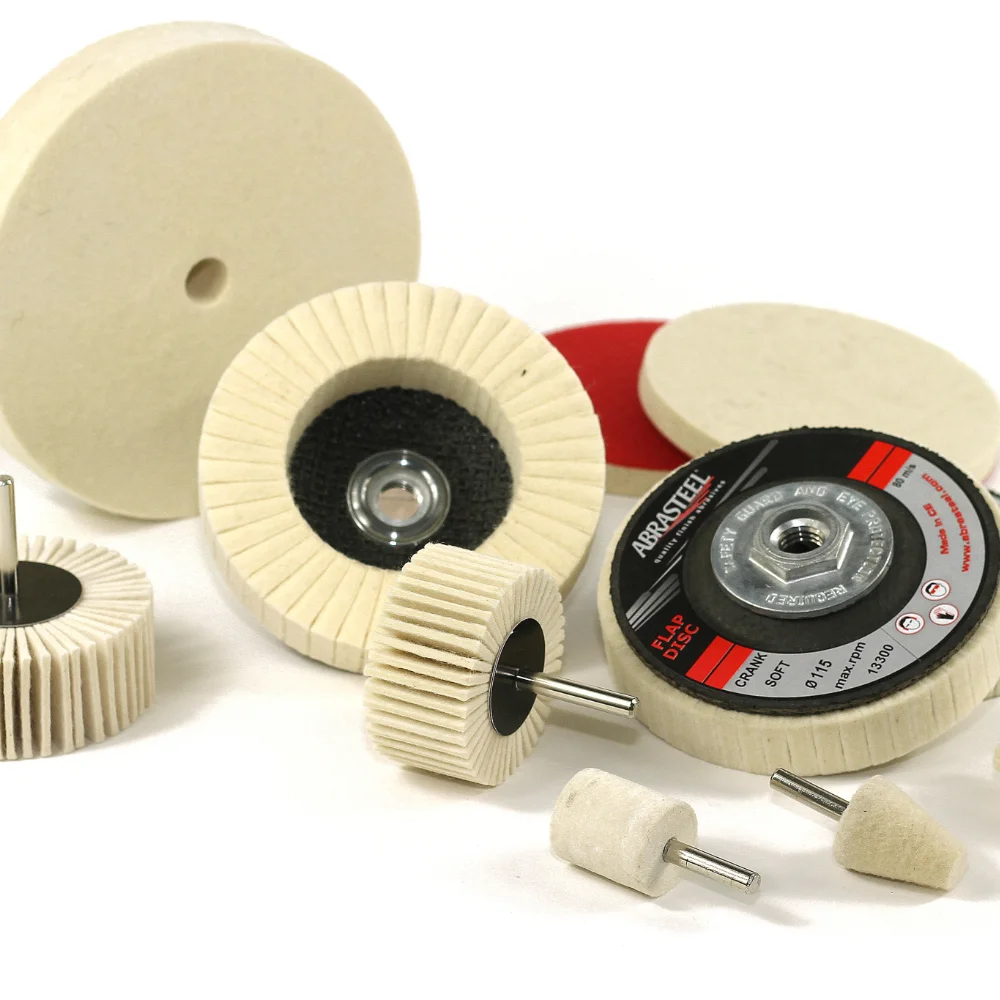
7 criteria for choosing polishing discs for industrial supply
1. The customer’s machine before the consumable
Each polishing format is made for one machine, and the mounting system makes that clear. The crank disc on a fibre backing has an M14 thread for an angle grinder; the felt crank disc with velcro backing is for a random orbital sander; felt, cotton or rope brushes with a 19 mm keyway go on a satin finisher; stitched cotton discs, with an 8 mm bore and from 100 to 400 mm, on a spindle polisher; and crank points and brushes with a 6 mm shank, on a straight grinder or drill.
That is why the first question at the counter is what they are going to polish with. If the customer only has an angle grinder, the offer comes down to the M14 formats and velcro backing pads; if they have a satin finisher, the keyway range opens up; and with a spindle polisher, the large-diameter cotton and rope discs. Organising the shelf by machine means that question leads straight to the right rack.
2. Working speed: polishing runs much slower than a grinder
Polishing products work well below the speed of a grinder. The crank disc on a fibre backing gives an optimum speed of 1,650 rpm and a maximum of 8,500 rpm; the felt crank disc with velcro, an optimum of 3,700 rpm and a maximum of 10,000 rpm; and the felt crank brush with keyway allows a maximum of 3,800 rpm in 100×50 and 2,900 rpm in 100×100. A 115 mm grinder without speed control runs above all those figures.
That has two consequences for the distributor. Polishing consumables for a grinder are sold by asking whether the machine has speed control, and if it doesn’t, it is worth offering one that does or steering the customer to another format. And the marked maximum speed is never exceeded: an over-revved felt heats up, burns the compound before it can work and can stain the part.
3. Process step: refining, pre-polishing and buffing
Polishing is a sequence in which each step removes the marks of the previous one. The agglomerated cloth velcro disc, in grits from 120 to 1200, covers intermediate and final polishing and leaves a very low roughness; the crank on fibre is made in HARD and SOFT to go from pre-polishing to buffing; and among the compounds, the pink one is for pre-polishing, while the white, the green or the blue liquid finish the shine.
At the counter the question is what the previous step has left. If the customer is coming from an 80 grit flap disc and wants a mirror finish, selling them only buffing compound is selling them frustration: they are missing the intermediate steps. A printed diagram of the sequence helps complete the sale; our guide to achieving a mirror polish is a good starting point.
4. Compounds by colour and function, with a backing for each one
With compounds, the colour indicates the function. In the Abrasteel range, the pink compound is for pre-polishing and combines cut and shine; the blue, for medium polishing; the white, for dry polishing with shine; the green, for greasy polishing with added lubrication; the pumice prepares the metal before final buffing; and the tallow extends the life of discs and belts on non-ferrous metals. The liquid compounds follow the same logic: the pink polishes and prepares, and the blue brings up the shine after the pink.
Along with the compound, the customer needs to take away the rule of use: one disc for each compound, marked, without mixing them. A cutting compound left on the buffing felt scratches the part on the last pass. If someone buys two compounds and a single disc, the order is one disc short, and it is worth telling them.
5. Density and hardness of the backing: soft, medium or hard
The same type of backing is made in several hardnesses. The crank on fibre comes in HARD and SOFT; the impregnated rope discs and the impregnated rope and cotton discs, in medium (red) and hard (green); and the felt in most crank brushes and points is medium density. A hard backing cuts more and withstands pressure; a soft one conforms to the shape of the part and spreads the shine better.
Density multiplies codes just as grit does with flap discs, so it pays to know which parts your customers polish: flat surfaces tolerate harder backings, while tubes, handrails and parts with radii call for something that follows the curve. With that you can decide which hardnesses to keep on the shelf.
6. Stainless, aluminium or carbon steel: what changes in the range
Stainless is the material that drives the most polishing, and it has its own references: the stitched rope and cotton disc, plain or impregnated, is designed for polishing stainless, and the pyramidal abrasive velcro discs refine stainless parts before polishing. Material used on carbon steel never touches stainless again.
Aluminium and non-ferrous metals have a different need, because soft material loads up abrasives. That is where tallow paste comes in, extending the life of discs and belts on those materials. And if the polished stainless is going into an installation with corrosion requirements, remind the customer that mechanical polishing and passivation are different operations: if the specification calls for passivation, it is done separately.
7. Accessories and box sizes that complete the sale
A polishing disc cannot be used without its backing. Velcro discs need a compatible backing pad; core brushes, their centring adapter; and satin finisher sleeves, an expansion drum, pneumatic or centrifugal. The Abrasteel velcro disc backing pad, with 11 mm foam and an M14 connection, is made in 75, 115 and 125 mm.
Boxes also count when calculating stock. Rope and stitched cotton discs from 100 to 200 mm come in boxes of 10, and those from 250 to 400 mm in boxes of 2; the felt crank disc with velcro, also in boxes of 2. For slow-moving references, setting minimum stock in boxes avoids material sitting idle for months.
Applications and technical table by customer machine
With polishing discs for industrial supply it pays to organise the range by the customer’s machine rather than by material or type of backing. The machine decides which formats can be fitted and at what speed they run.
The table summarises the most common machines, the format they take and what to check before selling.
| Customer machine | Format it takes | What to check before selling |
|---|---|---|
| 115 or 125 mm angle grinder | Crank disc on M14 fibre backing and M14 velcro backing pads. | Speed control: the crank’s optimum speed is 1,650 rpm. |
| Random orbital sander | Felt crank disc with velcro and velcro discs. | Backing pad diameter and the grit left by the previous step. |
| Satin finisher | Felt, cotton or rope brushes with a 19 mm keyway. | Maximum brush speed: 3,800 rpm for the 100×50 felt crank. |
| Spindle or bench polisher | Stitched cotton discs and rope and cotton discs, from 100 to 400 mm. | 8 mm bore and whether the impregnated version is a better fit. |
| Straight grinder or drill | Felt crank points and brushes with a 6 mm shank. | Maximum speed according to the point diameter. |
Stainless metalwork shop asking for a mirror finish
This is the most common request and the one that hides the most steps. If the customer is coming from the flap disc, they are missing refining with an agglomerated cloth velcro disc or pyramidal abrasive, then pre-polishing with pink compound on rope and cotton and, finally, buffing with another disc and another compound. Selling the complete sequence stops them coming back saying they can’t get the shine.
Maintenance workshop that only has a grinder
Many plant workshops polish with what they have: a 115 mm grinder without speed control. The format that fits is the crank on M14 fibre backing, in HARD for pre-polishing and SOFT for buffing, but at controlled speed. If the customer polishes often, a machine with speed control such as the AGF110/1010E satin finisher, which runs between 1,800 and 3,900 rpm, also opens up the whole keyway range for them.
Manufacturer repeating the same finish every week
When a customer makes runs of furniture or stainless parts with a fixed finish, what they need is for their sequence not to change: the same backing, the same compound and the same hardness in every order. Writing it down on their customer record and reserving stock by the box avoids substitutions that change the appearance.
Common mistakes when selling polishing products
The underlying mistake is selling polishing as if it were a stand-alone consumable. A felt disc or a compound works within a sequence and on a specific machine; outside that context, the customer doesn’t get the finish and blames the product.
Selling buffing compound to someone coming from a coarse grit
Shine compound doesn’t remove the scratches of a 60 or 80 grit abrasive. Without the intermediate steps, the part still has scratches under the shine. Always ask what grit they are coming from.
Fitting felt or cotton on a grinder at full speed
It is the typical shortcut in workshops without a satin finisher: the consumable runs far above its optimum speed, heats up and burns the compound, and in the worst case exceeds the marked maximum speed. Always ask about speed control.
Using the same disc for several compounds
A disc that has worked with cutting compound carries grit into the buffing step and scratches the part at the end. Each compound needs its own disc or brush, and the customer should know this when buying.
Selling the disc without the backing pad or mounting accessory
A velcro disc without a backing pad, a core brush without a centring adapter or a sleeve without a drum stays in the workshop unused. On the first order of each format, check with the customer what they have to mount it.
Abrasteel polishing consumables for industrial supply

Crank disc on fibre backing
M14 fitting for an angle grinder, in HARD and SOFT density, from pre-polishing to buffing. Optimum at 1,650 rpm.

Stitched rope and cotton disc
Stitched rope and cotton plies for polishing stainless, from 100 to 400 mm with an 8 mm bore.

Agglomerated cloth velcro disc
For intermediate and final polishing, in grits from 120 to 1200: leaves a very low roughness before the compounds.

Pink compound
Pre-polishing compound that combines cut and shine and prepares the surface for the final finish.
The full range is in rope, cotton and felt discs, polishing compounds and satin finisher brushes, and the rubber and velcro backing pads complete the assembly. To check sizes, densities and speeds before setting your range, see the technical catalogue.
Abrasteel as a technical supplier for industrial supply
At Abrasteel we manufacture and distribute polishing products, and we work with warehouses, industrial hardware stores and distributors that sell them to all kinds of workshops. In this family the customer asks for a result, shine, and the counter has to translate it into a machine, a speed and a sequence.
- We help you organise your polishing range by machine and decide which hardnesses to keep on the shelf.
- We prepare sequence diagrams, from grit to compound, for your counter team.
- We give you the optimum and maximum speeds of each format so you can sell safely.
- We adjust minimum stock to the units per box of each slow-moving reference.
If you want to review your range of polishing discs for industrial supply or prepare answers for your customers, you can write to us from the contact page and we will go through it with your range in front of us.
The complementary operation, weld dressing with flap discs before polishing, is covered in flap discs for industrial supply.
Frequently Asked Questions (FAQs)
How does this guide differ from the one on flap discs for industrial supply?
The flap disc guide covers dressing and finishing the weld bead, the intermediate step. This one covers the last step: polishing and buffing with felt, cotton, rope, velcro and compounds, and how to organise that range by the customer’s machine.
Can you polish with felt on a standard angle grinder?
With the right format, such as the crank disc on M14 fibre backing, yes, but at controlled speed: its optimum speed is 1,650 rpm and its maximum 8,500 rpm. Without speed control, the grinder runs faster and the felt heats up and burns the compound.
Which polishing compound should I recommend to a customer who wants a mirror finish?
A single compound is not enough. The usual approach is pre-polishing with pink compound and final buffing with another shine compound, each on its own disc. Before that, the surface has to be refined to a fine grit.
Can I use the same disc with several compounds?
It is not recommended. The disc retains the previous compound and, if it was a cutting compound, scratches the part during buffing. The right approach is a disc or brush marked for each compound.
Which polishing products should I keep in stock if my customers work with stainless?
Stitched rope and cotton discs, plain or impregnated, velcro discs for refining and pink compound for pre-polishing, plus a shine compound. Store them separately from material used on carbon steel.
What is tallow paste and who should I sell it to?
It is a compound that extends the life of discs and belts when working non-ferrous materials such as aluminium.
Abrasteel advice
Selling polishing products to workshops?
We help you organise your range by machine and by step.
Contact us
Leave us your details and one of our sales representatives will contact you shortly.