
Flap Discs for Industrial Supply in 2026
Abrasive discs
Technical guide to stocking and selling flap discs for industrial supply: which grits, diameters, shapes and backings to keep on the shelf, how to keep the stainless range separate and what to ask at the trade counter when a workshop comes in for a disc to dress weld beads.
These are the 7 criteria we recommend reviewing:
- What the customer is going to dress: fillet weld, edge or large surface
- Grit and diameter matrix that actually moves out of the warehouse
- Fibreglass backing with a 22 mm bore or plastic backing with an M14 thread
- Dedicated stainless reference, labelled and kept apart on the shelf
- Abrasive and cloth ladder: from entry level to heavy use
- Marked speed, the customer’s machine and the EN 13743 standard
- Diagnosis at the counter when the disc “doesn’t last” or leaves marks
An industrial supply distributor sells flap discs almost every day, and rarely to the person who knows most about them. In comes the foreman of a metalwork shop asking for “a 125 flap in 60 grit”, or a buyer repeating last month’s order without knowing which disc each operator uses. Choosing the right flap discs for industrial supply means deciding what goes on the shelf so that everyone leaves with the right disc and doesn’t come back with a complaint.
The flap disc is the consumable for the intermediate step, between grinding and polishing or painting, and the family that piles up the most variants in a warehouse: four grits, three diameters, two shapes, two mounting systems and several abrasives, which multiplied together give dozens of codes.
Getting it wrong shows in the warehouse and at the counter: boxes of grits that don’t turn over while the 125 mm in 60 grit runs out on a Monday, M14 discs that come back as returns, or a disc used on carbon steel and then on stainless that ends in a complaint about rust spots. Below are the seven criteria we use with distributors, a table of trade counter questions and the mistakes we see most often.
This guide covers the flap disc and the operation it handles in your customer’s workshop: dressing and finishing the weld bead. The recurring-purchase side it shares with the rest of the abrasives, such as stock continuity, batch-to-batch consistency or documentation, is already covered in industrial supply cutting discs and industrial supply grinding discs, and the next step, polishing and buffing, in polishing discs for industrial supply. For types and grits of the family without the sector filter, the reference is abrasive flap discs.
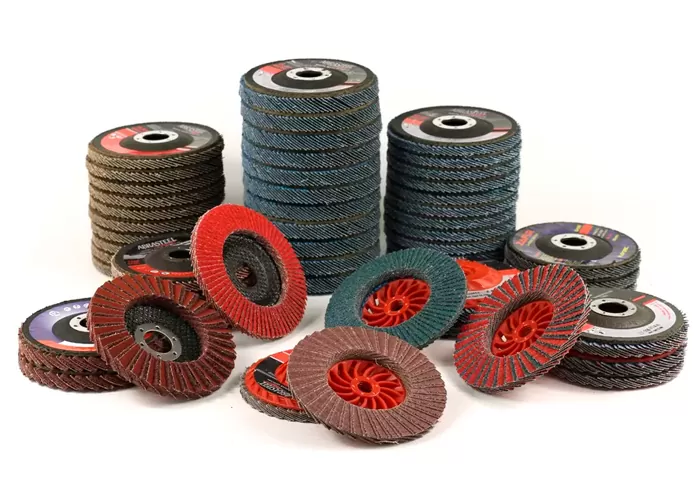
7 criteria for choosing flap discs for industrial supply
1. What the customer is going to dress: fillet weld, edge or large surface
The first question is not the grit, but what the operator is going to do with the disc. Almost all flap disc consumption splits between three jobs: blending a weld bead into the plate, breaking the sharp edge of a cut part and dressing a large surface before painting or moving on to polishing.
On fillet welds and in corners a conical disc works better, because it works with the edge; on large flat surfaces a flat disc performs better, because it puts more cloth on the workpiece. If the customer doesn’t know which shape they use, ask how they tilt the grinder: someone working with the grinder almost flat on the plate needs a flat disc, and someone attacking the bead with the edge of the disc needs a conical one. Stocking both shapes in your best-selling diameters avoids the most common wrong sale.
2. Grit and diameter matrix that actually moves out of the warehouse
General-purpose flap disc references are made in grits 40, 60, 80 and 120 and in diameters of 115, 125 and 178 mm; in the ZAFIR and the BASIC, for example, the size table comes from crossing those values. Covering every cell in both shapes means twenty-four codes per reference, and few warehouses move them all.
Before expanding, look at your sales by grit and diameter. Normally the bulk is concentrated in 115 and 125 mm, and the 178 mm is requested by a few customers with large machines. That one can be supplied to order.
3. Fibreglass backing with a 22 mm bore or plastic backing with an M14 thread
Two mounting systems coexist in the flap disc range. Most references have a fibreglass backing with a 22 mm bore and are fitted with the grinder’s flange and nut. Others, such as the TURBO and the TURBO INOX, have a plastic backing with an M14 thread and screw straight onto the machine spindle, with no nut.
The M14 saves time at every change, but you have to ask about the machine: most 115 and 125 mm grinders sold in Spain have an M14 spindle, but there are spindles with other threads and machines that work with adapters. Labelling on the shelf which discs are threaded and which have a bore avoids the typical return of the disc that won’t fit.
4. Dedicated stainless reference, labelled and kept apart on the shelf
A workshop working with stainless needs discs that have never touched carbon steel, because the iron particles carried by a used disc embed in the stainless and later show up as rust spots. For the distributor that means a dedicated reference, such as the TURBO INOX, placed apart and labelled.
Separation also depends on how it is supplied: a returned disc put back in the stainless box is behind many complaints. In the stainless range, sales by the unit should always be made from the original box.
5. Abrasive and cloth ladder: from entry level to heavy use
Within the family, what sets one reference apart from another is mainly the abrasive and the amount of cloth. The BASIC is the value-for-money entry level; the ZAFIR, the general-purpose reference for all kinds of metals; the EXPERT combines zirconia in coarse grits and aluminium oxide in fine ones; the CERAMIC is made in grits 40, 60 and 80 for stainless and ferrous metals; and the HEAVY DUTY has 70% more cloth than a conventional disc and is designed for work with coarse grits.
Moving up a step makes sense when the customer dresses many metres of weld a day or works with hard materials; in a workshop that does little dressing, the entry level is usually enough. The useful question at the counter is how many discs they use per week and on what material. With those two figures you can decide whether switching pays off.
6. Marked speed, the customer’s machine and the EN 13743 standard
Flap discs are coated abrasives and their European safety standard is EN 13743. What the distributor needs to watch is the maximum speed marked on the disc: in the references of the range it is 13,300 rpm at 115 mm, 12,200 rpm at 125 mm and 8,600 rpm at 178 mm. The rated speed of the grinder must never exceed that of the disc.
The 178 mm disc goes on 180 mm grinders and never on a faster machine with an adapter. And the HYBRID has one particularity: its table gives an optimum speed of 6,000 rpm at 115 mm and 5,500 rpm at 125 mm, well below the maximum, so it is best sold to customers who have a variable-speed grinder.
7. Diagnosis at the counter when the disc “doesn’t last” or leaves marks
The most frequent complaint is that the disc doesn’t last, and it almost always comes down to how it is used: the operator holds the disc too flat and wears the whole face at once, presses hard to make it cut faster, uses the disc to remove slag or excess weld that was a job for grinding, or has chosen a fine grit for a high bead. If the customer brings in the worn disc, look at it: an edge worn into a step or torn-off flaps point to different causes.
The other complaint is that the disc scratches and the marks show up when painting or polishing. That is usually a grit jump: finishing with 40 where 80 or 120 was needed. For bead height and base material, use our guide to flap discs for welding.
Applications and trade counter question table
In industrial supply you don’t see the application: you are told about it. That is why it pays to organise the range of flap discs for industrial supply around the requests that reach the counter, which are few and keep coming back.
The table lists the most common ones, the missing piece of information and what to offer from the shelf.
| What the customer asks for | What you need to ask | What to offer |
|---|---|---|
| “A 60 grit flap for dressing welds” | Material, grinder diameter and whether the weld is a fillet or on a flat surface. | ZAFIR or BASIC in 60 grit, conical for the fillet and flat for the surface. |
| “A disc for stainless that won’t leave stains” | Whether the disc will also touch carbon steel at the same workstation. | Dedicated TURBO INOX, supplied from its original box. |
| “Something that lasts longer than the one I’ve got” | Discs per week, material and how the operator works. | Check the use first; if consumption justifies it, EXPERT or HEAVY DUTY. |
| “Take the weld off and leave it ready for satin finishing” | Whether the grinder has speed control. | HYBRID, which grinds and satin-finishes depending on the working angle. |
| “A disc that doesn’t need a nut” | Thread of the grinder spindle. | TURBO or TURBO INOX with M14 plastic backing. |
Setting up the flap disc shelf in a new warehouse
We recommend starting with a short base: one general-purpose reference in 60 and 80 grit, in 115 and 125 mm and in both shapes; the stainless reference in the same grits; and 40 and 120 grit in smaller quantities. After that, the range grows with sales.
For minimum stock, count the units per box: the ZAFIR and the BASIC come in boxes of 30 in 115 and 125 mm and boxes of 10 in 178 mm; the TURBO, the TURBO INOX and the HEAVY DUTY, in boxes of 16.
A customer moving from carbon steel to stainless
When a carbon steel metalwork shop starts making stainless railings, the first thing it needs from its supplier is the separation rule: stainless discs only for stainless, stored apart and never passed from one workstation to another. It is worth explaining this on day one.
The second is that the flap disc does not complete the finish on exposed stainless: satin finishing or polishing comes afterwards. Our guide to stainless steel finishes helps them decide what final appearance they are after, and with that information the sale is complete.
A complaint about excessive consumption
If a customer says the new batch lasts less, ask for the used disc and the batch number. Comparing it with a disc from the previous batch separates a product problem from a change in use in just a few minutes.
Common mistakes when selling flap discs
The underlying mistake is treating the flap disc as a generic consumable sold by diameter and grit, with no further questions. It is the family that depends most on how the operator works, and that is where a distributor with know-how stands apart from one that just ships boxes.
Selling flap discs to remove slag and excess weld
On a high bead, oxy-fuel cutting slag or a heavy burr, the flap disc wears out very fast and the customer comes back saying it doesn’t perform. That job belongs to grinding discs, and the flap disc comes in afterwards.
Keeping stainless and carbon steel discs in the same drawer
With stainless and general-purpose boxes stored together and unlabelled, sooner or later a carbon steel disc ends up in a stainless workshop and the stain appears weeks later.
Filling the shelf with every grit and diameter combination
Holding all twenty-four codes of each reference ties up stock that barely turns over and takes space away from what sells out. A short, well-stocked base with the rest to order is better.
Selling the HYBRID or the 178 mm disc without asking about the machine
The HYBRID performs at a low optimum speed, and the 178 mm disc only goes on 180 mm grinders. Selling them without asking ends in a poor result or a risk to the operator.
Abrasteel flap discs for industrial supply

BASIC flap disc
Entry level with value for money, for all kinds of materials, in grits 40 to 120 and in 115, 125 and 178 mm.

ZAFIR flap disc
General-purpose reference for all kinds of metals, with fibreglass backing and the full matrix of grits and diameters.

TURBO INOX flap disc
Dedicated to stainless steel on flat surfaces, with an M14 plastic backing that fits without a nut. Box of 16.

HYBRID flap disc
Ceramic and surface conditioning flaps that grind and satin-finish in one step depending on the working angle.
The full range is in Abrasteel flap discs. If a customer is torn between flap discs and fibre discs for dressing welds, our guide to the differences between fibre discs and flap discs helps them decide, and the technical catalogue lists grits, diameters, speeds and units per box for the whole family.
Abrasteel as a technical supplier for industrial supply
At Abrasteel we manufacture and distribute, and we work with warehouses, industrial hardware stores and distributors that sell flap discs to all kinds of workshops. The sale is decided at the counter, with questions about the machine, the material and the job.
- We help you size the grit, diameter and shape matrix according to your actual sales.
- We prepare counter information: speeds, mounting systems and which reference to offer for each request.
- We separate the stainless range and show you how to label and supply it.
- We review the used discs from a complaint with you to tell a usage cause from a product cause.
If you want to review your shelf of flap discs for industrial supply or train your counter team, you can write to us from the contact page and we will go through it with your sales figures in front of us.
The complementary operation, the polishing and buffing that come after dressing with flap discs, is covered in polishing discs for industrial supply.
Frequently Asked Questions (FAQs)
How does this guide differ from the one on grinding discs for industrial supply?
The grinding guide covers the recurring purchase of discs for stock removal. This one focuses on the flap disc and dressing the weld bead: which grits, shapes and backings to stock and what to ask at the counter.
Which flap disc grits and diameters should always be in stock?
As a base, 60 and 80 grit in 115 and 125 mm, in flat and conical shapes, and the stainless reference in the same grits. The rest, according to your own sales.
When should I sell a conical flap disc and when a flat one?
The conical disc works with the edge and gets into fillet welds and corners better. The flat disc puts more cloth on the work and performs better on large surfaces with the grinder held almost flat.
What is the advantage of the M14 backing over the 22 mm bore?
The disc with an M14 backing screws onto the grinder spindle without a nut, and changing it is quicker. In return, the machine spindle has to be M14: ask before selling it.
Which safety standard applies to flap discs?
Flap discs are coated abrasives and the European safety standard that applies to them is EN 13743. Always check that the maximum speed marked on the disc is equal to or higher than that of the grinder.
What do I tell a customer who says their flap disc doesn’t last?
Ask for the used disc and find out what job they do. Usually they work with the disc too flat, press too hard or use flap discs to remove slag or excess weld that was a job for grinding. If the use is correct, compare it with a disc from the previous batch.
Abrasteel advice
Selling flap discs to workshops?
We help you organise the shelf and your counter answers.
Contact us
Leave us your details and one of our sales representatives will contact you shortly.