
Cutting Discs for Metal Fabrication in 2026
Abrasive discs
Technical guide to choosing cutting discs for metal fabrication in the workshop: cutting sections, tube and sheet to length in runs for prefabrication, parts that go straight into the welding jig, and control of burr and squareness.
These are the 7 criteria we recommend checking:
- Cutting station: abrasive chop saw, angle grinder or both in the same workshop
- Cutting list: runs of identical parts versus one-off fitting cuts
- Section being cut: tube, open section, flat bar or sheet
- Squareness and length tolerance so the part fits the jig
- Burr and heat-affected edge on the face that will be welded
- Keeping discs separate in a workshop that mixes steel, stainless and aluminium
- Disc thickness, machine speed and consumption per cutting shift
In a metal fabrication shop, cutting is the first operation on almost every work order, and also the one repeated most often. Before the welder tacks a frame together, someone has had to cut twenty 40×40 tubes from the bar to the same length, forty flat-bar gussets and the sheet strips for the stiffeners. Choosing the right cutting discs for metal fabrication decides whether those parts reach the assembly bench ready to go into the jig or whether each one needs reworking before it is welded.
What sets the workshop apart from a site job or a repair is repetition. A cut slightly out of square on a one-off part is corrected in a minute; the same defect across a run of a hundred cross members opens gaps at every joint and distorts the assembly during welding. That is why cutting discs for metal fabrication are judged on how they cut part number fifty, not on how quickly they go through the first one.
Cutting also shapes the work of the stations further down the line: an internal burr on a tube stops it fitting over the spigot of a joint, and a length that wanders by half a millimetre between parts adds up across a six-module frame. In this guide you will find the seven criteria we review with prefabrication shops, how they apply by type of part and the mistakes we see most often at the cutting station.
It is worth defining the scope clearly. If you are looking for general criteria on material, diameter, thickness and range regardless of sector, the reference is our guide to cutting discs for metal. If your work is cutting structural sections during erection or on site, or parts already installed, the articles on cutting discs for structural steel and metal structure cutting cover that scenario. And the overview of every abrasive family on the line is in metal fabrication abrasives. This article stays at the workshop cutting station: cutting to length, in runs, for parts that are going to be welded. The operations that follow are covered in grinding discs for metal fabrication and flap discs for metal fabrication.
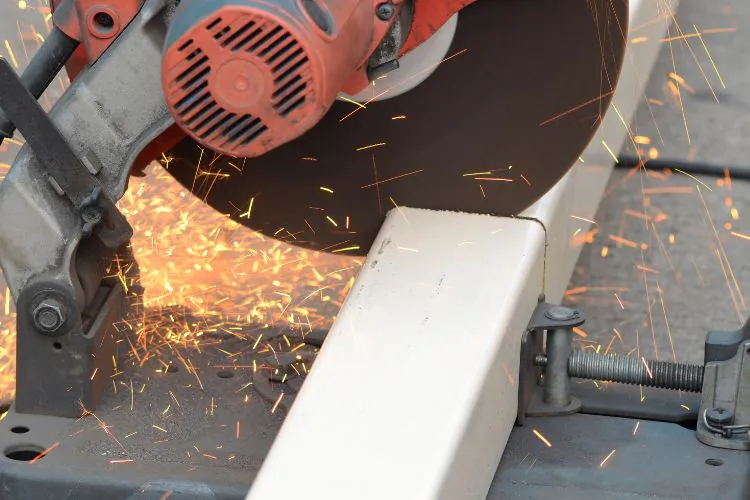
7 criteria for choosing cutting discs in metal fabrication
1. Cutting station: abrasive chop saw, angle grinder or both in the same workshop
Most fabrication shops have two ways of cutting with abrasives. The abrasive chop saw, with a vice and a pivoting arm, is used to cut tube and light sections to length against a fixed stop; the angle grinder is kept for sheet trimming, fitting work at the bench and cuts the chop saw cannot reach. Many workshops also have a bandsaw for heavy and solid sections, and each machine should have a clear role, because each one calls for a different disc or none at all.
On a 115 or 125 mm grinder the operator corrects the cutting path with their body; on the chop saw the disc comes down guided by the arm, and any sideways flex shows up as an out-of-square cut. Before talking about references, draw up an inventory of the workshop’s cutting machines with their diameter, bore and maximum speed.
2. Cutting list: runs of identical parts versus one-off fitting cuts
The cutting list says a lot about which disc is right. When the work is runs of identical parts, such as frame cross members, shelving uprights or workbench legs, you want a reference that behaves the same from the start of the batch to the end, because the operator sets pressure and feed on the first few parts and then works from memory. For one-off fitting cuts, what you need is a disc that handles well on the grinder.
For long runs we recommend sorting the bar stock before cutting: group parts of the same section together and cut the long ones first. That way the disc wears on consistent work and it is easier to see when it needs changing.
3. Section being cut: tube, open section, flat bar or sheet
Cutting thin-wall tube is not the same as cutting 10 mm flat bar. In tube, the disc enters and leaves the material several times along the cut, passing through the corners and the faces, and if the feed is abrupt when it reaches the bottom wall a burr forms on the inside. In open sections such as angle or UPN channel, the thickness changes between web and flange, and the disc has to hold the line as it moves from one to the other.
Sheet in strips is cut with a grinder and a straightedge, and the problem is holding the line on long cuts without heating the sheet until it distorts. That is why it makes sense to have at least two disc thicknesses: a thin one for tube and sheet, and a stiffer one for thick flat bar and solid sections.
4. Squareness and length tolerance so the part fits the jig
A part that goes into a welding jig has to fit without forcing. If the cut comes out of square, the joint is left open on one side; the welder fills it with extra filler metal and the additional heat pulls the assembly. Over several consecutive joints the error adds up and the assembly ends up twisted or out of dimension.
On the chop saw, squareness depends on three things: the vice being properly calibrated, the part being supported along its full length and the disc not flexing on the way down. A disc that is too thin for the section, or forced with heavy pressure, bends inside the cut and leaves an angled face. If the workshop produces CE-marked steelwork to EN 1090, cutting also falls under its factory production control, and part tolerances are set by EN 1090-2: one more reason to fix the disc and the procedure for each station.
5. Burr and heat-affected edge on the face that will be welded
Abrasive cutting always leaves some burr and a band of heated edge; what changes with the disc is how much. The burr on the outer edge comes off with one pass; the burr left on the inside of a tube cannot be seen and stops end caps, inserts or joint spigots from going in.
When the cut edge goes straight to welding, it should come out clean and free of burnt scale. In thin sheet and tube the preparation is usually a square butt, and the cut edge is the joint itself; at greater thicknesses it will need bevelling afterwards, using the preparations set out in EN ISO 9692-1, and that is already the job of the grinding station. The better the cut, the less time is spent at that second station.
6. Keeping discs separate in a workshop that mixes steel, stainless and aluminium
On the same day a fabrication shop may have a run of carbon steel frames, a stainless steel balustrade for a customer and some aluminium sections for a curtain wall. If the cutting station uses the same disc for everything, the stainless is contaminated with steel particles that later rust, and the aluminium clogs the edge of the disc until it stops cutting.
The practical answer is to assign a disc to each material and label it: one box for steel, another for stainless and another for aluminium. If the chop saw works almost entirely on steel, it is easier to keep it for steel and cut stainless and aluminium with a grinder at a separate station.
7. Disc thickness, machine speed and consumption per cutting shift
Disc thickness determines stiffness, heat and the material lost with each cut. The TOP cutting disc, for example, comes in thicknesses of 1, 1.6, 2, 2.5 and 3.2 mm: the 1 mm disc gives a narrow, fast cut in tube and thin sheet, while the 2.5 and 3.2 mm discs stand up better to side pressure in thick sections. In a run of a hundred parts, the millimetre of difference in kerf width also counts when calculating the length of each part.
There is no margin on speed: the machine speed must never exceed the speed marked on the disc, and the EN 12413 standard requires bonded abrasive discs to carry that information. In the TOP range, the 115 mm disc runs up to 13,300 RPM, the 125 mm up to 12,200 RPM, the 180 mm up to 8,600 RPM and the 230 mm up to 6,600 RPM. With that settled, the last figure is consumption: counting how many discs the station uses per shift is the simplest way to know whether the reference works for your runs.
Applications and technical table by workshop part
When choosing cutting discs for metal fabrication, it is better to sort by type of part and by machine before sorting by material. A square tube on the chop saw and a strip of sheet cut with a grinder can be the same steel and call for very different discs.
The table below summarises the parts that most often leave the cutting station in a prefabrication shop, the factor that most affects the result and the disc approach we recommend in each case.
| Part and machine | Main constraint | Recommended disc approach |
|---|---|---|
| Square or rectangular tube for frames, on the chop saw | Repeatable squareness and burr on the inside of the tube. | Thin, stiff disc suited to the section, with steady feed through the bottom wall. |
| Angle, UPN channel and flat bar for gussets and stiffeners | Change in thickness between web and flange, and more time inside the material. | 2.5 or 3.2 mm thickness so the disc does not flex and holds the line. |
| Sheet strips and trimming with a grinder | Straight line on long cuts and heat that distorts the sheet. | 1 or 1.6 mm disc and passes guided by a straightedge, without rushing. |
| Stainless parts for balustrades and metalwork | Ferritic contamination and edge discolouration. | Dedicated stainless reference, at a separate station or in a separate box. |
| Aluminium sections for curtain walls and light frames | Disc clogging and a cut that stops advancing. | Specific disc for aluminium and soft materials. |
Cutting tube for frames and welded structures in runs
This is the most typical job in a prefabrication shop: machine frames, brackets, industrial shelving, trolleys and tables. The tube is cut on the chop saw against a length stop and the parts go to a jig where they are tacked. If squareness or length varies, the jig no longer does its job and the fitter has to shim or clamp every joint.
The stop and the vice are checked once; the disc wears part by part, and that is where deviations appear halfway through a batch. That is why we recommend measuring again every so many parts and always after changing the disc.
Sections and flat bar for gussets, plates and stiffeners
Gussets, base plates and stiffeners are cut from flat bar or open sections, often at an angle. The disc spends more time inside the material, and one that is too thin bends and leaves a wedge-shaped face that will not then sit flat against the section.
For these parts we prefer thicker discs and a steady feed, and checking the gusset with the workshop square before sending it to assembly.
Sheet trimming and fitting work at the assembly bench
At the assembly bench the grinder deals with whatever has not come out of the cutting station right: a piece of sheet trimmed for a cap, a length adjustment or a fitting cut on a part that has already been offered up. These are short cuts, sometimes with the part held only by a G-clamp, and what matters most is control: a disc that cuts without needing pressure and a stance that keeps the hand steady.
If there is a lot of fitting work at the bench, check the cutting station first: it is usually a sign that the cutting list, the stop or the chop saw disc is not set up properly. For heavy boilermaking, with thick plate and shell courses, the dedicated article is cutting discs for boilermaking.
Common mistakes when cutting to length in runs
The mistake we see most often is starting a run without measuring the first part. The problem shows up when the welder tries to assemble the frame and nothing fits, with the material already cut and the correction left to be done by hand, part by part.
Forcing the feed on the chop saw to finish the run sooner
Leaning on the chop saw arm to make the disc come down faster is the quickest way to lose squareness. The disc flexes, heats up, the edge turns blue and the burr increases. A forced disc also wears unevenly and stops cutting straight before its time. A steady feed that lets the disc do the work finishes the run sooner than a forced one with stops to correct parts.
Leaving the burr for the welder
Sending parts to assembly without removing the burr moves the work to a more expensive station that is less well equipped to do it. The welder has to file it or run a grinder over it with the part already in the jig, and if they do not, the joint is left with a gap or with dirt in it. The sensible approach is for the cutting station to deliver the parts deburred.
Using the same disc for steel, stainless and aluminium
Using the disc already on the machine to cut a stainless part or an aluminium section “because it is only one” usually turns out to be expensive: steel particles are left on the stainless and show up as rust spots after delivery, and on aluminium the disc clogs.
Supporting the part badly and letting the cut pinch the disc
When the bar is not supported along its full length, the material drops at the end of the cut and closes the kerf on the disc: that is when it snatches and the disc can break. Roller stands at table height and the part held firmly in the vice prevent most of these cases.
Abrasteel cutting discs for the fabrication shop

TOP cutting discs
For ferrous alloys and stainless, from 115 to 230 mm and in thicknesses from 1 to 3.2 mm for thin tube or thick sections.

BASIC cutting disc
Fast cuts in steel alloys, 1.6 mm thick in the most common sizes and 2 mm in the larger ones.

XTREM cutting disc
Designed for stainless steel, from 115 to 230 mm and from 1 to 2 mm, so you can keep a dedicated stainless box in the workshop.

ALU cutting disc
Specific to aluminium and soft materials, 1.3 mm thick in 115 and 125 mm.
The full range is in Abrasteel cutting discs, and for the deburring and bevelling that come after cutting you can check the grinding discs family. If you want to check diameters, thicknesses, speeds and box formats before fixing the reference for each station, the technical catalogue covers the data for the whole range.
Abrasteel as a technical supplier for metal fabrication
At Abrasteel we work with prefabrication shops, industrial metalworkers and makers of frames and welded structures, and we know that at the cutting station the technical conversation starts with the run: which sections are cut, on which machine, to what tolerance and what happens to the part right after cutting.
- We review the workshop’s inventory of cutting machines to match the diameter, bore and maximum speed of each reference.
- We propose disc thicknesses by type of section, keeping tube and thin sheet separate from flat bar and thick sections.
- We help you separate references by material so that stainless and aluminium do not share a disc with steel.
- We provide continuity of supply so the cutting station does not change reference halfway through an order.
If you want to review which cutting discs for metal fabrication suit each station in your workshop, or you have squareness or burr problems and are not sure whether they come from the disc or the machine, you can write to us from the contact page and we will go through it with your parts and your cutting list in front of us.
For finishing the welded parts once they have been cut and assembled, the companion guide covers the criteria for polishing metal fabrication parts.
Frequently Asked Questions (FAQs)
What is the difference between this guide and the one on cutting discs for metal?
The guide to cutting discs for metal covers the general product criteria: material, thickness, diameter, range and safety, without a specific sector. This one focuses on the cutting station of a fabrication shop: parts cut to length and in runs, with the chop saw and the grinder, which then go into the welding jig.
Abrasive chop saw or angle grinder for cutting tube in runs?
For runs of tube and light sections to the same length, the chop saw with a vice and fixed stop gives more repeatable, square cuts. The grinder is kept for sheet trimming, fitting cuts at the bench and parts that do not fit in the chop saw. For heavy and solid sections, many workshops prefer the bandsaw.
What disc thickness is best for cutting sections to length?
It depends on the section. For thin-wall tube and sheet, a 1 or 1.6 mm disc cuts quickly with little material loss. For thick flat bar, angle or UPN channel, a 2.5 or 3.2 mm disc stands up better to side pressure and holds the line without bending inside the cut.
How do I get repeatable square cuts across the whole run?
By calibrating the chop saw vice, supporting the bar along its full length, using a disc stiff enough for the section and not forcing the feed. Measure the first part before starting the run and repeat the check every so many parts and after every disc change.
Does the burr from cutting have to be removed before welding?
Yes. The burr, especially the one left on the inside of the tube, stops parts fitting properly in the jig and leaves dirt in the joint. The most efficient approach is for the cutting station to deliver the parts deburred, or for there to be a defined deburring step before assembly.
Can I use the same disc for steel, stainless and aluminium in the workshop?
It is not advisable. A disc that has cut steel leaves particles on stainless that later rust, and aluminium clogs the disc until it stops cutting. The practical approach is to have one reference and one box per material, and if the chop saw works almost entirely on steel, to cut stainless and aluminium at a separate station.
Abrasteel advice
Cutting sections and tube in runs?
We help you set the disc and thickness for each cutting station.
Contact us
Leave us your details and one of our sales representatives will contact you shortly.