
Polishing Discs for the Energy Sector in 2026
Finishing and polishing
Technical guide to choosing polishing discs for the energy sector: finishing stainless steel welds in hydrogen and biogas plants, cleaning contact surfaces in substations and polishing repaired areas on hydraulic turbines and shafts during shutdowns.
These are the 7 criteria we recommend reviewing:
- What you are polishing for: corrosion, electrical contact or hydraulic surface
- Heat tint and passivation on stainless steel welds
- Roughness or finish set by the manufacturer or the specification
- Busbars and connections: bare aluminium versus silver- or tin-plated
- Geometry that must not change: hydraulic profiles, seats and shafts
- Machine and speed available on the plant or in the field
- Consumables kept separate by material and ready before the shutdown
On an energy installation, polishing comes at the end of a repair or an erection job, once the cutting, grinding and dressing are done. It is the step that leaves the stainless steel weld on a hydrogen line ready for pickling, the face of an aluminium busbar clean so the connection can be tightened again, or the built-up blade of a turbine with the finish the manufacturer calls for. Choosing the right polishing discs for the energy sector decides whether that surface holds up in service or fails again at the next inspection.
The difference from a finishing shop is the objective. Here shine matters little; what matters is corrosion resistance, contact resistance or hydraulic shape. And almost everything is done within a shutdown with a fixed restart date, using whatever machine can be carried to the work point.
Choosing wrong has a cost that shows up months later: rust spots on a stainless steel weld that was polished but not passivated, a connection that heats up again because a silver-plated contact was sanded, or a runner that cavitates again because the finish changed the profile. Below you will find the seven criteria we apply, how they change by installation and the most common mistakes.
This guide covers polishing and final finishing. Dressing beads and edges and preparing for testing and painting are covered in flap discs for the energy sector; bevel preparation, in grinding discs for the energy sector; and cutting pipe and sections, in cutting discs for the energy sector. For the grit sequence and backing pads in the family, regardless of sector, the reference is polishing discs in metal fabrication.
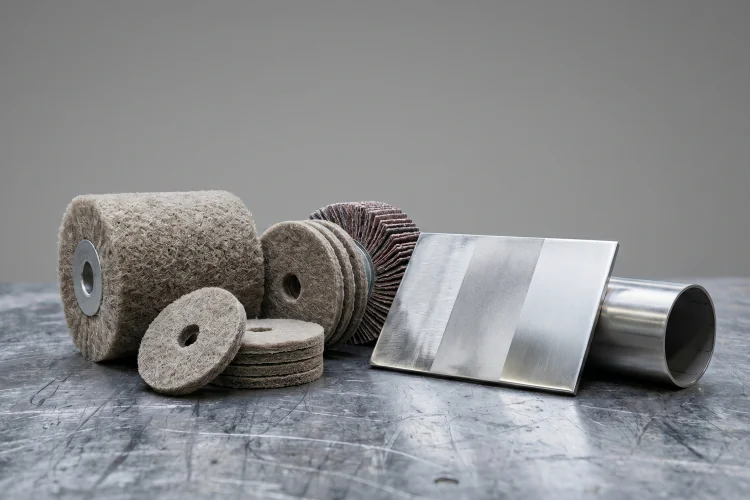
7 criteria for choosing polishing discs in the energy sector
1. What you are polishing for: corrosion, electrical contact or hydraulic surface
In energy you almost never polish for looks. You polish the weld on a stainless steel pipe so it resists corrosion, you clean the face of a busbar so the connection does not heat up, or you leave the repaired area of a runner smooth so the water does not start tearing metal away again. Each objective calls for a different consumable and a different way of working.
That is why the first question we ask is not which disc, but what the surface has to do when the installation is running again. That answer decides whether a non-woven is enough, whether you need to bring roughness down through several grits, or whether the priority is not to touch the geometry.
2. Heat tint and passivation on stainless steel welds
Welding stainless steel leaves a coloured band around the bead, the heat tint, where the passive layer of the steel has been damaged. In the circuits of a hydrogen or biogas plant, with moisture and aggressive media, that band is where corrosion starts if nobody treats it.
The treatment combines two steps: removing the colour and roughness with a fine conditioning abrasive, without heating the part, and then pickling and passivating. Many project specifications refer to ASTM A380 for cleaning and descaling stainless steel and to ASTM A967 for passivation. Polishing to a shine without that second step leaves a weld that looks good and has no protection.
3. Roughness or finish set by the manufacturer or the specification
Some equipment arrives with a written finish requirement: a maximum Ra roughness on the wetted surface, a specific satin finish on an enclosure or a seat area that does not accept transverse scratches. If the specification gives a value, it is measured with a roughness tester, not by eye.
To bring roughness down in an orderly way, you work in steps, never skipping more than one grit at a time and changing the direction of the pass so you can see when the previous scratch pattern disappears. Agglomerated cloth, with grits from 120 to 1200, allows that progression on the same machine.
4. Busbars and connections: bare aluminium versus silver- or tin-plated
In a substation, a bolted connection that is running hot is usually picked up by maintenance thermography. When it is dismantled, the contact faces in bare aluminium are cleaned with a non-woven abrasive or a brush to remove the oxide layer, and the specified contact grease is applied before reassembly, because aluminium oxidises again in a short time.
Silver- or tin-plated faces are a different matter: the plating is what provides the contact and an abrasive removes it. There, cleaning is done only with the product specified by the equipment manufacturer. And all this work is done de-energised, applying the five golden rules of Spain’s Real Decreto 614/2001.
5. Geometry that must not change: hydraulic profiles, seats and shafts
In a hydroelectric plant, cavitation tears metal away from blades and Pelton buckets, and the usual repair is to build up with weld, grind back to profile with templates and then apply the finish. In that last phase the abrasive must only refine: if it changes the profile, the area will cavitate again. A velcro disc on a random orbital sander makes it easier to control how much comes off.
The same applies to shafts and seal seats. An angle grinder on a journal leaves flats that show when the shaft turns. Those surfaces are polished with abrasive cloth strip, with the shaft turning or by hand, and the diameter is checked before and after.
6. Machine and speed available on the plant or in the field
During a plant shutdown the normal approach is to work with a variable-speed angle grinder or a random orbital sander, not the workshop bench polisher. Felt discs for random orbital sanders run at lower speeds than a flap disc: the felt crank disc with velcro backing, for example, between 3,700 and 10,000 RPM. A grinder without speed control burns it and leaves marks.
If the part can be removed and taken to the maintenance workshop, the fixed polishing machine opens up other options: sisal and stitched cotton mops, with an 8 mm bore, work stainless steel with compound and give a more even finish than any portable machine.
7. Consumables kept separate by material and ready before the shutdown
Stainless steel pipe, carbon steel structure and aluminium busbars all share the same shutdown. An abrasive that has been on steel leaves iron on the stainless, and one loaded with stainless residue or grease does not clean an aluminium contact properly. The practical approach is to prepare one kit per material, marked and stored separately.
Shutdown windows are set months in advance and they are not extended for a consumable. It pays to close the list of discs, backing pads and compounds in good time and have the stock on site before day one.
Applications and technical polishing table by installation
With polishing discs for the energy sector, it pays to organise the choice by the function the surface has to perform rather than by the material. The same stainless steel is treated differently if it is a pipe weld or the enclosure of an outdoor cabinet.
The table summarises the most common situations in process plants, substations and hydroelectric plants, with the constraint that governs each one and what the consumable has to deliver.
| Installation and situation | Main constraint | What the consumable must deliver |
|---|---|---|
| Stainless steel pipe weld in a hydrogen or biogas plant | Heat tint and iron contamination. | Fine non-woven or agglomerated cloth dedicated to stainless, before pickling. |
| Stainless steel enclosure or cabinet in a solar plant or substation | Outdoors, on view and with an original satin finish. | Surface conditioning following the direction of the satin finish. |
| Bare aluminium busbar in a bolted connection | Oxide that forms again in a short time. | Cleaning with non-woven and immediate assembly with contact grease. |
| Built-up hydraulic turbine blade or Pelton bucket | A profile that must not be altered. | Controlled refining with a velcro disc on a random orbital sander, grit by grit. |
| Journal or seal seat on a pump or turbine shaft | Shaft diameter and roundness. | Abrasive cloth strip, never an angle grinder. |
Stainless steel in hydrogen, biogas and cooling plants
In these plants, stainless steel pipe and tanks are welded during erection and at every extension. After dressing with a flap disc, finishing with a surface conditioning disc or agglomerated cloth removes the heat tint and leaves the area ready for INOX pickling paste, which is applied to the weld with a brush.
The order matters: mechanical finishing first, then pickling and passivation, and finally a thorough rinse. We explain it in more detail in our guide to passivating stainless steel.
Substations: connections and enclosures
Connections that thermography flags as hot are opened at the next shutdown. On bare aluminium, a medium-grade non-woven abrasive cleans off the oxide without thinning the busbar. You work in one direction, clean off the dust and reassemble straight away to the tightening torque set by the manufacturer.
Stainless steel cabinets and enclosures on a solar plant or a coastal substation end up with surface rust stains. They are recovered with surface conditioning in the same direction as the original satin finish, and sometimes the Restore restorer is enough, as it respects the polished or satin finish.
Hydroelectric plants and shafts during shutdowns
Cavitation repair is done during the annual shutdown or a major overhaul, with the turbine open and little space around the runner. The final refining, with a velcro disc on a random orbital sander, is checked with the same templates used to grind the profile.
On shafts, the seal area is polished with abrasive cloth rolls cut to size, turning the shaft if the set-up allows, and the diameter is measured at the end.
Common mistakes when polishing on energy installations
The most common mistake is treating polishing as a cosmetic job. In energy, a surface can look very good and still fail if nobody has thought about what it has to do.
Polishing stainless steel to a shine and leaving it without pickling or passivation
The shine hides the heat tint from view, but the passive layer is still damaged. On a line with moisture, the first corrosion spots appear next to the bead within a few months.
Running an abrasive over a silver- or tin-plated contact
The plating is what guarantees contact resistance. Sand it off and the connection sits on the base metal and heats up again. If in doubt, check the equipment manual before touching the face.
Using a grinder without speed control with felt discs
At the speed of a standard angle grinder, the felt burns, the compound dries out and the surface is left stained. Use the random orbital sander or a variable-speed machine within the disc’s range.
Refining a hydraulic profile without a template
Polishing a built-up area by eye ends up taking more off one side than the other, and the profile changes. Check with the template during refining, not just at the end.
Abrasteel consumables for polishing in the energy sector

Surface conditioning velcro disc
Surface refining in 115, 125 and 178 mm, with grades from Extra Coarse to Very Fine.

Agglomerated cloth velcro disc
For intermediate and final polishing after grinding, with grits from 120 to 1200 and very low roughness.

Felt crank disc with velcro backing
For polishing and buffing with a random orbital sander: 115 mm, medium density, from 3,700 to 10,000 RPM.

INOX pickling paste
Cleaning and preparation of stainless steel after welding, in a 3 kg tub with a brush for applying it to the bead.
The surface conditioning disc is mounted on the surface conditioning disc backing pad, with an M14 thread in 115 and 125 mm. The rest of the range is in velcro discs and polishing compounds, and the technical catalogue lists formats and speeds for the whole family.
Abrasteel as a technical supplier for energy
At Abrasteel we work with maintenance companies for process plants, substations and power stations, and we know that in this sector the finish is decided by the function of the surface. Before proposing a disc, we ask what the material is, what it has to do in service and which machine will be used during the shutdown.
- We keep separate consumable kits for stainless steel, carbon steel and aluminium, so they do not get mixed up during the same shutdown.
- We match the grit sequence to the roughness or finish set by the equipment manufacturer.
- We propose discs, backing pads and speeds compatible with the random orbital sander or variable-speed grinder your team uses.
- We prepare the stock before the shutdown window, with a margin for the repairs that turn up once things are opened.
If you are planning a shutdown and want to finalise which polishing discs for the energy sector to take for each piece of equipment, you can write to us from the contact page and we will go through it with your work plan in front of us.
The complementary operation, dressing beads and edges to leave the weld ready for this finish, is covered in flap discs for the energy sector.
Frequently Asked Questions (FAQs)
What is the difference between this guide and the one on flap discs for the energy sector?
The flap disc guide deals with dressing the bead and edges, and preparing for testing, painting or zinc touch-up. This one deals with the final step: finishing stainless steel before pickling, cleaning contacts and refining repaired areas.
Is polishing a stainless steel weld enough to stop it rusting?
No. Polishing removes heat tint and roughness, but the passive layer is restored by the pickling and passivation that follow. Without that step, the weld looks good and is left unprotected.
How do I clean the contact face of an aluminium busbar?
With the installation de-energised, using a medium-grade non-woven abrasive or a brush, in one direction and without thinning the busbar. Then apply the specified contact grease and reassemble straight away, because aluminium soon oxidises again.
Can a silver- or tin-plated contact be sanded?
No. The plating is what ensures good contact, and the abrasive removes it. Those faces are cleaned only with the product specified by the equipment manufacturer.
Which machine should I use for polishing with felt during a shutdown?
A random orbital sander or a variable-speed angle grinder within the disc’s range. The felt crank disc with velcro backing runs between 3,700 and 10,000 RPM; at the speed of a grinder without speed control it burns.
How do I polish the repaired area of a turbine blade without changing the profile?
By refining grit by grit with a velcro disc on a random orbital sander and checking with the template during the work, not just at the end. The aim is to bring down the roughness of the built-up area without reducing the profile.
Abrasteel advice
Preparing finishes for a shutdown?
We help you choose the consumable according to the function of each surface.
Contact us
Leave us your details and one of our sales representatives will contact you shortly.