
Cutting Discs for the Maritime Sector in 2026
Abrasive discs
Technical guide to choosing cutting discs for the maritime sector: on-board maintenance with the vessel in service, deck equipment, moorings and port structures, and offshore work.
These are the 7 criteria we recommend reviewing:
- Where the work happens: vessel in service, quayside or offshore installation
- Length of the port call window and consumables that must be carried on board
- Actual material of the part: marine steel, marine stainless, aluminium or galvanised
- Confined space, ventilation and hot work permit
- Working at height over water and control of the tool and the disc
- Salinity and humidity: storing discs on board and their expiry date
- Machine available at the work point and diameter and RPM limits
Abrasive cutting in the maritime sector almost never takes place at a fixed workstation with the part clamped to a bench. It happens on the deck of a vessel that is still operating, in an engine room reached by a vertical ladder, on a pontoon with the tide coming and going, or on a platform that can only be reached by boat. Choosing the right cutting discs for the maritime sector has less to do with the ideal material spec sheet and more to do with what the operator can actually do at that point, with that machine and in the time available.
The main difference from any other metalworking job is that the asset is not stopped. An owner who needs to free a seized fairlead, cut out a bent guardrail or remove a section of seawater pipe cannot take the vessel out of service for days. The job is fitted into a loading call, a short technical stop or a weather window, and the consumables have to be there before the window opens, because halfway through the job nobody can go ashore for another disc.
On top of that time pressure come the conditions of the environment. Salinity and constant humidity affect both the part and the stored consumables; confined spaces limit ventilation and call for control of sparks and fumes; and working at height over water turns any dropped tool into a loss that cannot be recovered. Choosing wrong here does not just mean using one disc too many: it means lengthening a stop, dragging a job on to the next port call or creating an avoidable risk in an area with hydrocarbons, paint and combustible material close by.
In this guide you will find the seven criteria we apply when a customer brings us a cutting job on a vessel in service, on the quayside or at an offshore installation; how they translate into disc choice by work area; and which mistakes we see most often in maritime maintenance. All the content is focused on work with the asset in operation, not on hull fabrication.
It is worth keeping apart two scenarios that are often confused. If your work is newbuilding or repair on the slipway and in dry dock, with the vessel out of the water and in the hands of the shipyard, the reference is our guide to cutting discs for shipyards, followed for the next operation by grinding discs for shipyards. This content covers the opposite: the vessel in service and the port and offshore environment, where work is done with the asset running. If you are looking for general product criteria regardless of sector, the parent content is cutting discs for metal.
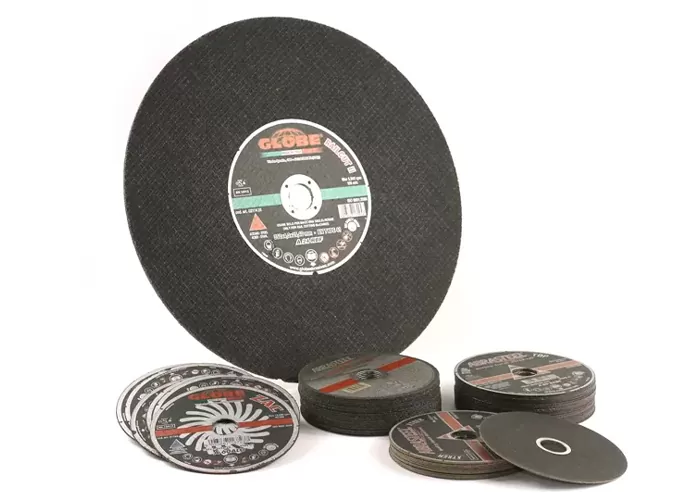
7 criteria for choosing cutting discs for the maritime sector
1. Where the work happens: vessel in service, quayside or offshore installation
All three scenarios share salt water, but they do not share working conditions. On board with the vessel in service there are crew, cargo and equipment running all around, and cutting is kept to the strict minimum. On the quayside you gain space and shore support, but you depend on the berth and the port schedule. At an offshore installation the constraint is access: anything that has not been shipped out beforehand is simply not there.
Before deciding on the reference, it pays to answer a simple question: how much margin is there to redo the job if it goes wrong? On the quayside it can be redone the next day; on an offshore platform or on a vessel sailing that same night, it cannot. That margin is what justifies taking a reference with predictable behaviour rather than whatever happened to be left in the storeroom.
2. Length of the port call window and consumables that must be carried on board
A twelve- or twenty-four-hour port call leaves no room for improvisation. The maintenance team boards with a closed list and anything missing means deferred work, so consumables are calculated on the generous side and in standard sizes, not by optimising unit cost. One extra disc weighs little; an unfinished job costs another port call.
This is where working with full-box formats and the same references across vessels of the same fleet helps. Abrasteel’s TOP cutting discs, for example, come in boxes of 50, a format that fits the logic of a ship’s storeroom well: a labelled box goes on board and is replaced whole, without counting loose discs at every port call.
3. Actual material of the part: marine steel, marine stainless, aluminium or galvanised
On a vessel in operation it is not only steel that gets cut. Within a few hours you can come across a section of stainless steel pipe in the seawater circuit, a stainless guardrail or handrail on deck, an aluminium section in the superstructure or on a gangway, and a galvanised grating or bracket in an exposed area. Each one calls for a different response from the disc.
The case that causes the most trouble is marine aluminium, common in superstructures, gangways and fast craft. Cutting it with a disc designed for steel quickly glazes the rim and the cut stops progressing. There is a specific reference for that material, just as for stainless it is best to keep one separate from carbon steel so as not to carry over particles that later encourage corrosion.
4. Confined space, ventilation and hot work permit
Engine rooms, tanks, storerooms and pump rooms are confined spaces, and any abrasive cutting inside them falls under the vessel’s hot work procedure: authorisation, atmosphere testing, removal of combustible material, and fire watch during and after the task. None of that depends on the disc, but it does determine how much actual cutting time is available.
With limited ventilation, the material being cut also matters. Galvanised steel gives off zinc fumes, and in an enclosed space that calls for local extraction and suitable respiratory protection. A cut completed in fewer passes reduces both exposure and the length of the fire watch afterwards.
5. Working at height over water and control of the tool and the disc
Cutting from a mobile elevating work platform, a basket, a scaffold hung over the side or a workboat completely changes the operator’s posture. With one hand busy holding on, control over the angle grinder drops, and with it the ability to correct a deviation halfway through the cut.
In that situation it is best to favour a cut that progresses without needing extra pressure, and machines secured with a safety lanyard, because anything that falls into the water is lost and anything that falls onto the deck can hit someone. Forcing the feed to finish sooner is precisely what makes the disc jam and the machine kick back.
6. Salinity and humidity: storing discs on board and their expiry date
Resin-bonded cutting discs are sensitive to humidity, and on board humidity is constant. Keeping them in their original packaging, lying flat in a dry, ventilated storeroom, is not a minor recommendation: it is what stops a box that came on board months ago from being in worse condition than on the day it arrived.
It is also wise to check the expiry date printed on the disc before using it, and to rotate the storeroom so the oldest stock is used first. In a shore warehouse this control happens on its own through consumption volume; on a vessel, where a box can sit for months at the back of a shelf, it has to be done deliberately.
7. Machine available at the work point and diameter and RPM limits
On board you do not always have the machine you would like, but the one that fits and the one you can power. A 115 or 125 mm angle grinder handles most jobs on deck and in tight spaces, while 230 mm equipment is kept for quayside work or open areas with better access and support.
The limit is not negotiable: the disc has a marked maximum speed and the machine must not exceed it. On the TOP cutting disc, for example, the 115 mm diameter runs up to 13,300 RPM and the 125 mm up to 12,200 RPM. Checking that the grinder on board respects that figure is part of preparing the job, not a formality for afterwards.
Applications and technical table on board and in port
In maritime maintenance it is better to organise the choice by work area rather than by material, because each area imposes a different restriction on access, ventilation and time. An open deck and a pump room do not allow the same approach even when the part is identical.
The table below sums up the most common situations when cutting is done with the vessel in operation, on the quayside or at an offshore installation, with the dominant restriction in each case and the disc approach we recommend.
| Area and situation | Main restriction | Recommended disc approach |
|---|---|---|
| Deck equipment with the vessel in operation | Crew and cargo around; cutting limited to the essentials. | 115 or 125 mm diameter and a steady feed without forcing pressure. |
| Seawater piping and stainless in circuits | Stainless contamination and temperature control. | Reference dedicated to stainless, not shared with carbon steel. |
| Aluminium superstructure and gangways | Disc glazing and the cut stalling. | Specific disc for aluminium and soft materials. |
| Engine room and confined spaces | Ventilation, fumes and hot work permit. | Cutting in fewer passes to reduce exposure and fire watch. |
| Moorings, fenders and port structures | Galvanised steel, advanced corrosion and work over water. | Versatile steel reference and machine secured with a lanyard. |
Deck equipment and anchoring gear
With the vessel in service, typical deck work means freeing or replacing an item that has become unusable: a seized fairlead, a lifeline stanchion bent by a heavy sea, a corroded plummer block bracket or a shackle that will not give. These are short, localised cuts, nearly always with a small grinder and very little room around the part.
What matters most here is not cutting speed but control. All around there is paint, rope, hoses and often cargo on board, so spark projection is contained with fire blankets and the job is planned to be done in one go, without coming back to the same area again.
Engine room, piping and confined spaces
Inside the vessel, cutting usually involves pipe supports, sections of pipe and auxiliary items of the circuits. When the line carries seawater and the material is stainless, it is best to use a reference dedicated to stainless and not the same one used earlier on carbon steel, so as not to leave particles that later turn into corrosion spots.
The other deciding factor is time. Every minute of cutting inside a confined space uses up ventilation, fire watch and work permit time, so a disc that cuts with a steady feed does not just save consumables: it shortens the whole associated operation, including the fire watch period afterwards.
Moorings, port structures and offshore work
Off the vessel, the same team ends up working on bollards, fenders, ladders, gangways and pontoon gratings, nearly always with advanced corrosion and galvanised material involved. Access is usually from a workboat or a platform, with the tide dictating the working window.
At offshore installations the logic is the same taken to the extreme: logistics run by boat or helicopter, the window depends on the sea state and there is no resupply in between. That is why the rule of shipping out predictable references, in full boxes and with the date checked, outweighs any other consideration.
Common mistakes when cutting with the vessel in service
The most expensive mistake is not technical but a planning one: going on board without having counted the consumables needed to finish the job. When the port call runs out with the part half cut, the cost is not a few discs, but organising access, permits and personnel all over again at the next stop.
The second is treating the ship’s storeroom like a shore warehouse. A box opened and stored any old way for months in a salty atmosphere does not arrive in the same condition it left in, and that deterioration is discovered just when the disc is needed most.
Using the same disc on carbon steel and on stainless in the circuit
This is the classic fault and the hardest to spot in time. A disc that has previously cut carbon steel carries particles that, applied to stainless, encourage surface rust. On a vessel, where the part is exposed to seawater all the time, that defect spreads much faster than in a shore workshop.
Forcing pressure to finish before the port call ends
When the clock is ticking, the temptation is to push the machine. The result is usually the opposite of what you want: heating of the part increases, the disc jams and the grinder kicks back, which at height or over water is exactly the scenario to avoid. A steady feed finishes sooner than a forced feed with stoppages.
Cutting galvanised steel indoors without extraction or respiratory protection
Galvanised gratings, brackets and handrails are common in exposed areas, and they are sometimes cut inside the vessel for convenience. Doing so produces zinc fumes that build up in a poorly ventilated space, so the operation must be planned with local extraction and suitable protection, or moved to an open area.
Not checking the disc before a job where there is no replacement
Before going down to a platform or heading out to an installation with no resupply in between, checking the condition, date and diameter of what you are taking costs a minute. Finding out at the work point that the disc is not compatible with the available machine costs the whole window.
Switching references between vessels of the same fleet without warning
If each vessel gets a different reference depending on what happened to be available, the operator adjusts pressure and speed by feel on every ship. Keeping a common reference across the fleet simplifies training, the storeroom and resupply, and means the disc behaves the same in every case.
Abrasteel cutting discs for maritime work

XTREM cutting disc
For stainless steel in seawater circuits and deck fittings, with diameters from 115 to 230 mm and thicknesses from 1 to 2 mm.

TOP cutting discs
Iron alloys and stainless in several sizes, in a box of 50 that fits in well with restocking the storeroom between port calls.

ALU cutting disc
Specific to aluminium and soft materials, 1.3 mm thick in 115 and 125 mm, for superstructures and gangways.
The full range is in Abrasteel cutting discs, and for the operation that follows cutting you can check the grinding discs family. If you need to check sizes, thicknesses and speeds before preparing a storeroom, the technical catalogue lists the available formats.
Abrasteel as a technical supplier for the maritime sector
At Abrasteel we work with maintenance teams who work on assets that cannot be stopped, and we know that in the maritime sector the technical conversation does not start with the material but with the work point: where the part is, which machine fits, how long the window lasts and whether there will be resupply or not.
- We help define the on-board consumables kit for each vessel, with standard sizes and quantities designed for a short port call.
- We separate references by material to avoid contamination between stainless, carbon steel and aluminium in the same storeroom.
- We check diameter and maximum speed compatibility with the grinders actually available on board.
- We standardise references across vessels of the same fleet to simplify training, the storeroom and resupply.
- We keep stock and continuity of supply for port jobs and offshore installations with tight logistics.
If you manage fleet maintenance, port services or offshore work and want to review which references should travel on each vessel, you can write to us from the contact page and we will look at it with your specific case in front of us.
For surface preparation and weld dressing on board, the companion guide is grinding discs for the maritime sector.
Frequently Asked Questions (FAQs)
What is the difference between this guide and the one on cutting discs for shipyards?
This guide covers the vessel in service and the port and offshore environment: on-board maintenance with the ship in operation, deck equipment, moorings and platforms. The shipyard guide covers the other scenario, newbuilding and repair on the slipway and in dry dock, with the vessel out of the water and in the hands of the shipyard.
How many discs should be taken on board for a short port call?
Always more than estimated and in standard sizes. If the port call lasts twelve or twenty-four hours there is no possible resupply, and an extra disc takes up little space compared with the cost of putting the job off until the next stop. Working with full, labelled boxes makes counting the storeroom between port calls easier.
Do cutting discs deteriorate when stored on board?
Resin-bonded discs are sensitive to humidity, and on board the atmosphere is constantly damp and salty. They should be kept in their original packaging, lying flat in a dry, ventilated storeroom; check the printed expiry date before using them and use the oldest stock first.
Can I use the same disc for the aluminium of the superstructure?
It is not advisable. A disc designed for steel glazes straight away when it goes into aluminium and the cut stops progressing, with the resulting heating of the part. For superstructures, gangways and aluminium sections it is best to carry a specific reference for aluminium and soft materials.
What needs to be taken into account when cutting inside an engine room?
That it is a confined space and that cutting falls under the vessel’s hot work procedure: authorisation, atmosphere testing, removal of combustible material and fire watch during and afterwards. The less cutting time the operation requires, the lower the exposure and the shorter the associated fire watch.
Which disc diameter is best suited to work on board?
On deck and in tight spaces, a 115 or 125 mm grinder covers most jobs thanks to its handling and access. 230 mm equipment is better suited to the quayside or open areas. In any case, check that the machine does not exceed the maximum speed marked on the disc.
Abrasteel advice
Maintenance on board or in port?
We help you define the consumables that should travel on each vessel.
Contact us
Leave us your details and one of our sales representatives will contact you shortly.