
Grinding Discs for the Maritime Sector in 2026
Abrasive discs
Technical guide to choosing grinding discs for the maritime sector: on-board repair with the vessel in service, salt corrosion pitting, deck equipment, port structures and offshore work.
These are the 7 criteria we recommend reviewing:
- Available intervention window: port call, short stop or work under way
- Type of corrosion already present: localised pitting or widespread rust
- Machine and power supply actually available on board or on the quayside
- Work in damp confined spaces: bilges, ballast tanks and double bottoms
- Working at height over water and on a moving deck
- Anchor profile required by the marine repair paint system
- Separating consumables for stainless and marine steel with a small storeroom
A vessel does not stop working because a pitted area appears on a hatch cover or a crack shows up in the bracket of a deck winch. The repair is done with the ship in operation, often during a port call of just a few hours, and that is where grinding discs for the maritime sector have to deliver what a workshop would do at leisure: open up the corroded area, clean back to sound metal, prepare the bevel and leave the surface ready for welding or for paint touch-up before the ship sails again.
The environment changes the rules completely. At sea and on the quayside you cannot turn the part round to work comfortably: the bracket is where it is, with the weld in the vertical or overhead position, sometimes on a hanging stage above the water. Nor is the corrosion the clean mill scale of freshly rolled plate; it is pitting from years of salt exposure that penetrates deep and hides sound material under a hard crust.
Choosing wrong in this scenario is paid for quickly. A disc that needs a lot of pressure turns a half-hour repair into a full shift inside a bilge with forced ventilation; grinding that leaves the surface polished ruins the anchor of the paint system and the area pits again within months; and sharing consumables between marine steel and stainless leaves rust spots on a handrail that was perfect. In this guide you will find the criteria we apply to maritime work, the typical applications on board and in port, and the faults we see most often when the clock is ticking.
It is worth keeping apart two scenarios that are often confused. If your work is in the shipyard (newbuilding and major repair with the vessel on the slipway or in dry dock, with a prefabrication shop behind it), the content covering that phase is our guide to grinding discs for shipyards, and for weld dressing and finishing in that same shipyard environment there is the one on flap discs for shipyards. This article covers the other side: the vessel in service and the port and offshore environment, where there is no slipway or dock and the work is done with the ship or installation in operation.
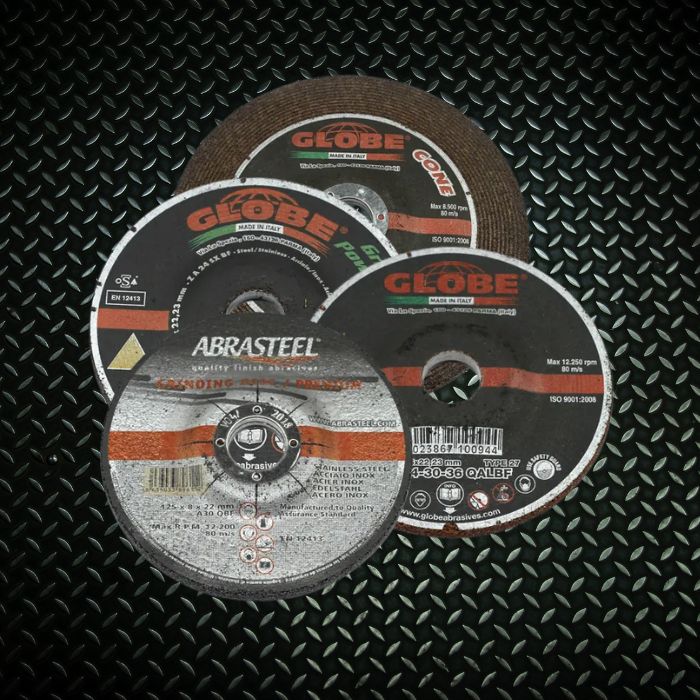
7 criteria for choosing grinding discs for the maritime sector
1. Available intervention window: port call, short stop or work under way
The first thing that shapes the choice is not the material but time. A repair during a port call may have six hours of margin between the last cargo operation and departure, and in that gap you have to clean up, prepare, weld and protect. When the window is short you want a reference that bites from the first pass and keeps up the pace, because every stop to change disc or to go down for another box eats into the margin that is left.
When working under way the approach changes again: there is no rush to sail, but there is a limit on the consumables carried on board. What is in the storeroom is all there is until the next port, so it is best to choose references that cover several operations rather than stock up on highly specialised products that only serve one specific case.
2. Type of corrosion already present: localised pitting or widespread rust
Corrosion on a vessel in service is nothing like that on a plate in a warehouse. Continuous salt exposure creates pitting that advances in depth under an outer layer that looks sound, and grinding has to reach the bottom of the pit to leave sound metal. If only the surface crust is removed, the area looks clean but the corrosion is still active and comes back with the paint system already applied over it.
When what you have is widespread rust over a large surface (a hatch cover, a stretch of bulwark, a davit), the problem is the opposite: removing a lot of surface without digging too deep or thinning the item. Telling the two cases apart before starting the grinder avoids both an inadequate repair and the needless loss of thickness on a structural item.
3. Machine and power supply actually available on board or on the quayside
During work on board there is not always a socket nearby, nor permission to run a cable along an engine room passageway. It is common to work with a pneumatic angle grinder connected to the ship’s air line, or with a battery machine on deck, and both deliver less sustained torque than a mains grinder in a workshop. A disc that needs pressure to bite performs poorly in those conditions and punishes the machine.
It is also worth checking the actual diameter that can be fitted. Many crews keep small grinders on board for ease of handling, not the big workshop machine, so the chosen reference must exist in the diameter the crew really has on the ship, not only in the usual shore format.
4. Work in damp confined spaces: bilges, ballast tanks and double bottoms
With the vessel in service, a confined space is never clean and ventilated: it comes with humidity, traces of seawater, sediment and sometimes hydrocarbon residues. Entry requires a work permit, atmosphere testing and forced ventilation, and anything that lengthens the operation inside also lengthens the operator’s exposure. A disc with consistent performance reduces the number of entries and exits needed.
Geometry is the other constraint. Between the stiffeners, frames and pipes of a double bottom the angle of approach is usually poor, and there a disc with a conical profile lets you reach into the corner without straining your wrist or hitting the adjacent member with the machine guard.
5. Working at height over water and on a moving deck
Repairing the base of a quayside crane, a port fender or part of an offshore structure means working at height, in a harness, and often over water. In that situation the free hand is not always truly free, and the operator cannot make up with pressure or posture for what the disc does not do on its own.
Add to that the movement: a moored vessel moves with the tide and with passing ships, and an offshore platform works in the swell. A disc whose performance depends on holding a constant angle gives uneven results when the footing moves under the operator’s feet.
6. Anchor profile required by the marine repair paint system
Paint touch-up on board does not have the blasting of a fixed facility: the mechanical preparation the disc leaves is, in practice, what will receive the primer. If grinding leaves the surface too smooth, the marine paint system finds no roughness to key into and the patch comes away prematurely, usually at the edge.
How the transition to the old paint around the repaired area is handled also matters. An abrupt edge concentrates stress and moisture right at the boundary of the patch; feathering that perimeter with the grinding itself helps the new coating overlap the existing one properly instead of lifting.
7. Separating consumables for stainless and marine steel with a small storeroom
On board you find painted marine steel, stainless sections in handrails, guardrails, service piping and galley equipment, and aluminium in some superstructures and gangways. The storeroom, on the other hand, is a cupboard, not a warehouse, and that lack of space pushes people to use the same disc for everything, which is exactly what should be avoided.
Ferritic contamination is especially treacherous in a salty environment: carbon steel particles left embedded in stainless rust quickly with the sea air and stain a part that was sound. Keeping a dedicated, physically marked reference, even if it takes up an extra slot in the storeroom, works out cheaper than reprocessing an entire handrail.
Applications and technical table on board, in port and offshore
In the maritime sector it is better to organise the choice by intervention scenario rather than by material, because the dominant constraint is almost never the steel: it is access, the time window and the impossibility of moving the part. The same repair on a workshop bench and at the foot of a davit are two different jobs even when the metal is identical.
The table below sums up the most common situations in maintenance with the vessel in operation and at port and offshore installations, with the restriction that governs each one and what the grinding disc has to deliver.
| Intervention scenario | Main restriction | What the grinding disc delivers |
|---|---|---|
| Pitted area on deck during a port call | A window of hours and a scheduled departure. | Bite from the first pass, with no disc changes mid-repair. |
| Bilge, ballast tank or double bottom | Humidity, controlled atmosphere and a poor angle. | Conical profile for the corner and steady performance with little pressure. |
| Deck equipment and auxiliary machinery | Fixed part that cannot be turned. | Control in vertical and overhead positions without relying on support. |
| Port structure and quayside davit | Working at height over water, in a harness. | One-handed handling and performance without extra pressure. |
| Stainless handrail, guardrail or pipe on board | Ferritic contamination in a salty environment. | Dedicated, marked reference not shared with marine steel. |
Spot repair on board with the vessel in operation
This is the most common case and the one that tolerates improvisation least. A crack or a thinned area appears in a stiffener, a bracket or the seat of a piece of equipment, and you have to clean around it back to sound metal, prepare the bevel for the filler and leave the surrounding area ready for protection. All without dismantling anything and with the rest of the vessel running a few metres away, which means controlling sparks, dust and projections from the very start.
The practical sequence we recommend is simple: mark out the affected area, remove the coating and corrosion products, check that the pit has been opened right to the bottom, prepare the weld geometry and feather the perimeter. Changing the order of these steps usually means starting again when the welder finds surprises under the crust.
Deck equipment, auxiliary machinery and mooring systems
Bitts, cleats, mooring fairleads, winches, boat davits and ship’s crane bases are items that work under fatigue, wet and with variable loads, and they usually give warning signs at the welds joining them to the deck stiffening. These are parts that cannot be taken to a bench: they are repaired where they are, with the disc going in wherever the equipment itself allows.
On these items grinding has to be selective. The aim is to open up the joint area without reducing the rest of the item or touching contact surfaces, and that calls for fine control in short passes rather than raw stock removal capacity.
Port structures and offshore installations
Off the ship, the same problem appears on quay fenders, ladders, gangways, pontoon railings, crane supports and the structures of an offshore installation. They all share two features: they are permanently exposed to the salty environment and they cannot easily be taken out of service, because the port or installation keeps operating around the repair.
Here grinding is often combined with other operations in the same job. To separate a damaged section before replacing it, cutting discs come in; to finish the weld once it has been made, flap discs; and to remove loose corrosion products in hard-to-reach areas, mounted brushes fitted to a small tool.
Common mistakes when grinding with the vessel in service
The mistake we see most often in maritime work is treating the on-board repair as if it were a workshop job with fewer tools. It is not: it is a different job, with a closed time window, no possibility of moving the part, and the ship or installation in operation all around. Planning the operation on workshop criteria almost always leads to running short of consumables or time.
The second fault is accepting an area on its appearance. In a salty environment, a surface that has turned grey and even can still hold corrosion products at the bottom of the pits, and that residue is enough for the defect to reappear under the new paint within a few months.
Closing the pit instead of opening it
Running the disc tangentially over a pitted area flattens the rim of the crater and leaves it looking smooth, but it seals the salt moisture and rust inside. It is best to attack the pit until you see clean metal at the bottom, even if that means removing a little more material than originally planned.
Leaving the surface too smooth for paint touch-up
Carrying on with the disc until the area is almost burnished is a common mistake when you are after a “finish”. The repair paint system needs roughness to key into, and without it the patch behaves like a layer resting on the surface, not bonded to it, and it flakes off at the edge as soon as the structure flexes.
Entering a confined space without allowing for all the consumables
Going down into a bilge or a ballast tank with a single disc means stopping the operation, coming out and repeating the entry permit if the reference runs out before you finish. Calculating consumables with a margin and taking them down in one go saves more time than any gain in the disc’s own performance.
Using the marine steel disc on the stainless on board
It is the typical shortcut when the storeroom is running low: using the disc already fitted to touch up a handrail or a stainless pipe. The result shows up weeks later as rust spots on a part that should not rust, and forces you to reprocess a visible surface that was fine.
Abrasteel grinding discs for maritime work

Grind Power grinding disc
For opening up pitted areas on marine steel when the intervention window is short and you need to bite from the first pass.

Conical grinding disc
Designed for the awkward angles of bilges, tanks and double bottoms, where the corner between stiffeners limits access.

Grinding disc for aluminium
A reference dedicated to the aluminium of superstructures, gangways and access points, to avoid clogging and overheating.
The full range is in Abrasteel grinding discs, and for clean-ups where you want to remove corrosion while taking off hardly any base metal, vulcanised and compressed fibre discs may be a better fit. To check the diameters and formats available before preparing the on-board storeroom, you can also consult the technical catalogue.
Abrasteel as a technical supplier for the maritime sector
At Abrasteel we work with maintenance teams who work with the vessel in operation, with port technical services and with companies that support offshore installations. We know that in this kind of work the conversation does not start with the catalogue, but with where the part is, how much time there is and which machine can get there.
- We help define a short on-board storeroom, with a few references that cover most jobs without taking up more space than necessary.
- We advise on the right profile and diameter for bilges, ballast tanks and confined spaces with a poor angle of approach.
- We separate references by material to avoid ferritic contamination of the stainless in handrails, guardrails and service piping.
- We provide continuity of supply for restocking between port calls and for port services with unscheduled jobs.
If your team carries out repairs on board, on the quayside or at an installation exposed to the sea, you can write to us from the contact page and we will review with you which references are worth keeping on board for the type of job you do most often.
We cover the complementary sectioning operation in the same environment in cutting discs for the maritime sector.
Frequently Asked Questions (FAQs)
Which grinding disc is best for repairs on board with the ship in service?
A reference that bites from the first pass and keeps performing without needing much pressure, because on board you work with pneumatic or battery grinders and in awkward positions. You also need the diameter the ship’s machine actually takes, not the usual one from the shore workshop.
How do I know if I have ground an area with salt corrosion pitting enough?
The benchmark is seeing clean metal at the bottom of the crater, not the surface turning grey and even. If the disc has passed tangentially and flattened the rim of the pit, the area will look cleaned up but will still contain moisture and rust, and the defect will come back under the new paint.
What is the difference between this guide and the one on grinding discs for shipyards?
The shipyard guide covers newbuilding and repair with the vessel on the slipway or in dry dock, with a prefabrication shop behind it. This one covers the vessel in service and the port and offshore environment: work with the ship in operation, a short time window and no possibility of moving the part.
Can grinding replace blasting before a marine paint touch-up?
In a spot repair on board there is usually no alternative: the mechanical preparation left by the disc is what receives the primer. The important thing is not to leave the surface burnished, because the coating needs roughness to key into, and to feather the perimeter so it overlaps well with the existing paint.
What should I bear in mind when grinding inside a bilge or a ballast tank?
As well as the entry permit, atmosphere testing and forced ventilation, take down all the consumables you have calculated, with a margin. Stopping work to come out for another disc means repeating the access procedure, and that costs more time than any difference in performance between references.
Do I need a different disc for the stainless of the ship’s handrails and pipes?
Yes. Sharing a disc between marine steel and stainless leaves embedded ferritic particles that, with constant salt humidity, rust in a short time and stain a sound part. It is best to keep a dedicated, marked reference, even if the on-board storeroom forces you to set aside an extra slot for it.
Abrasteel advice
Repairing on board or on the quayside?
We help you define your disc storeroom by type of job.
Contact us
Leave us your details and one of our sales representatives will contact you shortly.