
Flap Discs for Construction in 2026
Abrasive discs
Technical guide to choosing flap discs for construction: blending the weld bead on site-welded connections, breaking edges on stairs and metalwork, preparing for paint or galvanising touch-up, and cleaning up sections in refurbishment work.
These are the 7 criteria we recommend checking:
- What is being dressed: site connection, cut edge or existing section in refurbishment
- How much to blend the bead depending on whether it is exposed, painted or concealed
- Grit and sequence of passes when only one disc goes up to the work area
- Preparation grade and roughness required by the paint system
- Galvanised connections: minimum area and coating touch-up
- Working angle and disc shape at junctions and in awkward positions
- Dust, sparks and old paint in occupied buildings or refurbishment
On a job with structural steelwork or metalwork, the flap disc is the one used after the welder has finished and before the painter arrives. It dresses the weld on site, breaks the sharp edge of a flat bar cut on site, leaves the area ready for primer and, in a refurbishment, cleans up the old section before a stiffener is welded to it. Choosing the right flap discs for construction decides whether that intermediate step is done with a grinder and a couple of discs or turns into another day on site.
The difference from the workshop is the context. The operative works on a section that is already erected, often from a scaffold, without being able to turn the part and with other trades around. And almost everything dressed on site will end up under paint, a zinc touch-up or a coating, each with its own surface requirements.
Getting it wrong has a specific cost. A grit that is too coarse leaves scratches that the paint highlights; dressing that takes the bead down on a structural connection reduces the throat of the weld; and a surface that is too smooth gives the primer nothing to key into. Below are the seven criteria we apply on site, how they change by element and the most common mistakes.
This guide covers dressing and intermediate finishing with flap discs on site. Cutting rebar, sections and tube is covered in cutting discs for construction; heavy removal of excess weld metal, oxy-cutting slag and spatter in grinding discs for construction; and the final finish on exposed balustrades and handrails in polishing discs for construction. For product criteria for the family regardless of sector, such as grit types or disc shape, the reference is abrasive flap discs.
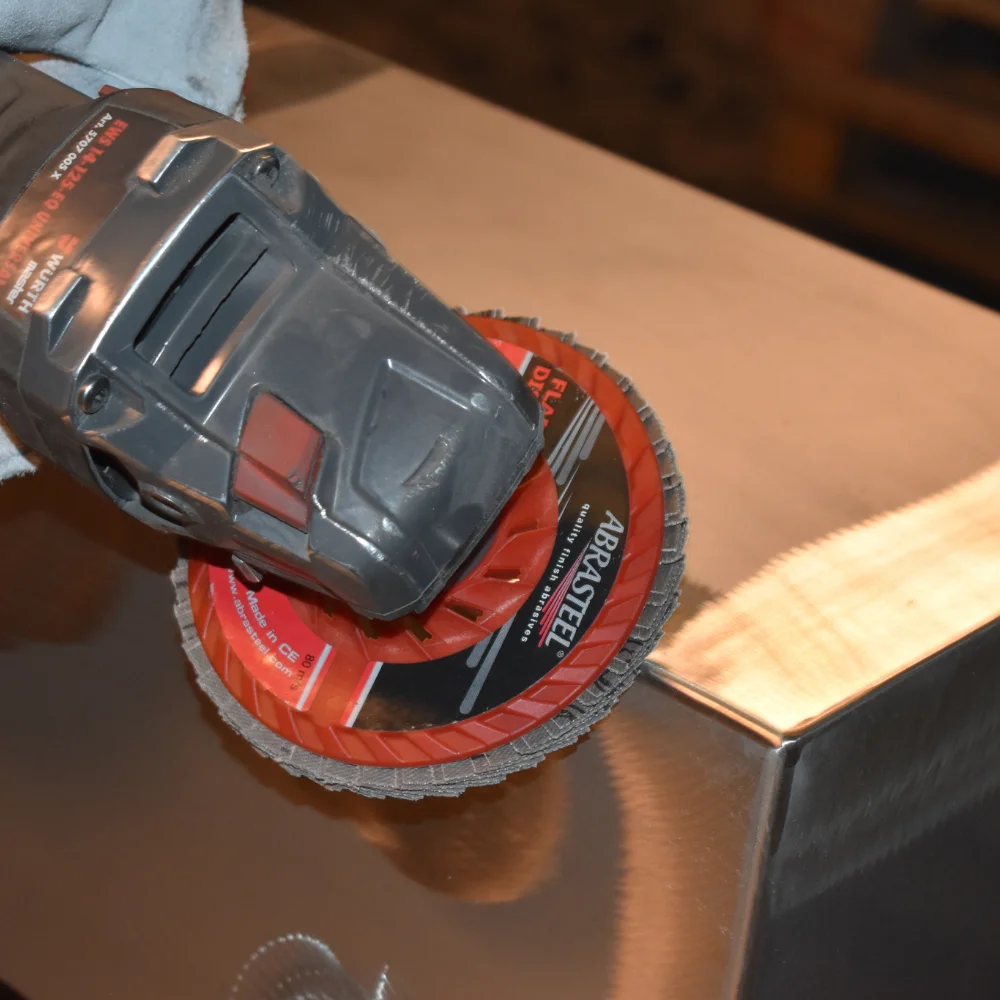
7 criteria for choosing flap discs in construction
1. What is being dressed: site connection, cut edge or existing section in refurbishment
In construction the flap disc ends up doing three very different jobs. The first is the site-welded connection: the column-to-beam junction, the splice of a stair stringer or the fixing of a balustrade to the slab edge. The second is the edge of flat bar, plate or section cut on site, which comes out sharp and with a burr. The third appears in refurbishment: existing sections with rust, old paint and mortar residue that need a stiffener welded on or need repainting.
On the connection, control comes first so as not to take off too much; on the edge, a short pass that rounds it without eating into the part; on the old section, stock removal and service life. Before making up the week’s box, find out which of the three dominates on the job.
2. How much to blend the bead depending on whether it is exposed, painted or concealed
A weld that will be hidden behind a lining only needs spatter and sharp edges removing. A connection that is going to be painted calls for a bead that is smoothed and free of steps, because they show under the paint. And on an element that will be seen close up, such as a stair balustrade, the bead has to be blended into the parent metal until it cannot be seen.
With one important caveat: on the fillet welds of a structural connection the bead is not ground flush. The load-bearing section depends on the throat, and reducing it can leave it below the design value. There, the disc smooths the profile and removes spatter; flush grinding has to be specified in the design.
3. Grit and sequence of passes when only one disc goes up to the work area
On site nobody goes up the scaffold with four different grits; one or two is the norm. Grits 40 and 60 remove excess metal and spatter quickly; 80 and 120 even out the surface and leave a finer finish. The ZAFIR, for example, is available in all four grits in 115, 125 and 178 mm.
For most structural work we recommend a 60 for the bead and an 80 or 120 to leave the area ready. If the connection arrives with a lot of excess weld metal or slag, grind first and use flap discs afterwards.
4. Preparation grade and roughness required by the paint system
If the element is painted, the surface the disc leaves is the one that receives the primer. The EN ISO 8501-1 standard defines the preparation grades for hand and power tool cleaning, St 2 and St 3, and the specification or the paint system data sheet commonly calls for one of them on touch-up areas. The EN ISO 12944 series, which governs corrosion protection of steel structures by paint systems, is usually what sets that requirement.
Paint also needs roughness to key into: an area dressed with fine grit until it is almost shiny loses adhesion and the touch-up peels at the edge. A disc with a lot of cloth such as the HEAVY DUTY, designed for coarse grits, leaves that uniform roughness over large surfaces.
5. Galvanised connections: minimum area and coating touch-up
On galvanised steelwork, site welding burns off the zinc around the connection and leaves a band of bare steel. EN ISO 1461, which covers hot-dip galvanising, allows those areas to be repaired with zinc-rich paint or thermal spraying, provided the surface is prepared first. The flap disc is the usual tool for that preparation.
Every pass that goes beyond the burnt area removes sound coating and enlarges the surface to be touched up. Limit the dressing to the bead and the affected band, with a medium grit and without lingering.
6. Working angle and disc shape at junctions and in awkward positions
On site the bead is wherever the connection is: at a beam-to-column junction three metres up, under a stair stringer or in the corner between a balustrade post and its base plate. The working angle is whatever the stance allows.
A flat disc works better on large surfaces at a low angle, while a conical one gets into fillet welds and corners more easily. With the side handle fitted and both hands on the machine, control improves considerably in awkward positions.
7. Dust, sparks and old paint in occupied buildings or refurbishment
Dressing produces fine dust and sparks, with other trades nearby and sometimes with the building occupied: cordon off the area, move insulation and plastic sheeting out of the way and use the protection specified in the risk assessment. Flap discs are coated abrasives and their safety standard is EN 13743: the maximum speed marked on the disc takes precedence over the grinder’s.
Refurbishment carries an added risk: older structures may have lead-based paint. Before dressing an existing section, check with the site management what coating it has and, if in doubt, plan the removal with local exhaust ventilation. For removing old paint, rust or cement residue without taking off metal, Clean Strip discs usually work better than flap discs.
Applications and technical table by site element
With flap discs for construction, it is better to sort the choice by element rather than by material, because each one imposes a different constraint on access, subsequent finish and risk. The same steel connection calls for different dressing depending on whether it is painted, galvanised or concealed.
The table below summarises the elements most often dressed with flap discs on site, the constraint that governs each case and what the disc needs to deliver.
| Element and situation | Main constraint | What the flap disc delivers |
|---|---|---|
| Column-to-beam welded connection that will be painted | Fillet weld that cannot be reduced below the throat. | Smooth the profile and remove spatter with grit 60 or 80, without grinding flush. |
| Painted steel balustrade or handrail splice | Surface that is touched and seen close up. | Blending the bead into the parent metal and moving to grit 120 before priming. |
| Cut edge of flat bar, stringer or stair tread | Sharp edge and burr from cutting on site. | Edge breaking with a short pass at a low angle. |
| Existing section in refurbishment | Rust, old paint and a large surface. | Stock removal and service life with coarse grit, after prior cleaning. |
| Site connection on galvanised steelwork | Burnt zinc and sound coating around it. | Localised preparation for touch-up, without going beyond the area. |
Site-welded connections on steelwork that will be painted
This is the most frequent job on building steelwork: column-to-beam connections, gussets and plates welded on site, which the disc leaves free of spatter and with the roughness the touch-up paint requires.
The sequence we recommend: remove spatter with a medium grit, smooth the bead without reducing it and finish with a slightly finer grit if the area will be visible. If the connection needs inspection, dressing is done first.
Painted steel stairs, balustrades and metalwork
On stairs, steel balustrades and metalwork, the parts arrive from the workshop and are adjusted or welded on site. The aim when dressing connections and edges is that the area cannot be told apart from the rest once painted. A sharp edge on a stair tread or handrail is also a hazard for users.
If the element is stainless and exposed, the flap disc prepares the area and the final finish moves on to polishing; we cover that in polishing discs for construction. On stainless it is best to use a dedicated reference, not shared with steel, such as the TURBO INOX.
Existing sections in refurbishment work
In refurbishment it is common to strengthen beams or weld new elements to sections with decades of service, which come with layers of paint, rust and mortar or plaster residue. Before welding, the connection has to be clean metal.
In this case the flap disc works after prior cleaning with Clean Strip or a wire brush, which removes what would clog the flaps. To choose a method according to the degree of rust, our guide on how to remove rust from metal compares the options.
Common mistakes when dressing with flap discs on site
The mistake we see most often is using the flap disc for everything, including slag and excess weld metal that belong to grinding: it uses up discs and takes longer.
Grinding the bead of a structural connection flush
Leaving a fillet connection flat looks like a good finish, but on a structural weld it removes load-bearing section. Unless the design calls for it, smoothing the bead profile without going below the throat is enough.
Finishing with coarse grit on an area that will be painted
To avoid changing discs on the scaffold, the area is left with grit 40 marks, which the topcoat highlights. On visible connections, finish with a finer grit.
Leaving the area too smooth before priming
The opposite extreme fails too. Working with fine grit until the area shines reduces the adhesion of the paint, and the touch-up starts lifting at the edge. The roughness specified in the paint system data sheet takes precedence over the appearance of the bare surface.
Dressing the galvanising beyond the burnt area
Running the disc over the whole part to even it out removes sound zinc and enlarges the area to be touched up, which never protects as well as the original galvanising.
Abrasteel flap discs for construction

ZAFIR flap disc
For all types of metal, with a fibreglass backing and grits 40, 60, 80 and 120 in 115, 125 and 178 mm.

EXPERT flap disc
Zirconia cloth in coarse grits and aluminium oxide in fine grits, for dressing weld beads without losing cutting capacity.

HEAVY DUTY flap disc
With 70% more cloth than a conventional disc, for coarse grits and a uniform roughness before painting.

TURBO INOX flap disc
Dedicated to stainless steel, with an M14 backing that fits without a nut, for flat surfaces.
The full range is in Abrasteel flap discs. For prior cleaning of old paint, rust and cement in refurbishment you can check the Clean Strip discs, and the technical catalogue lists grits, diameters and speeds for the whole family.
Abrasteel as a technical supplier for construction
At Abrasteel we work with structural steelwork, metalwork and refurbishment contractors, and we know that on site the question does not start with the disc but with what comes next: whether the connection will be painted, galvanised or concealed, whether the element will be seen close up and where the work can be done from.
- We help define a short box of grits to take up to the work area, without carrying references that are not used.
- We review which areas are going to paint or to galvanising touch-up to match grit and roughness.
- We keep separate references for stainless and steel on jobs with mixed metalwork.
- We provide continuity of supply throughout the job, including last-minute dressing before handover.
If you coordinate structural, metalwork or refurbishment packages and want to review which flap discs for construction to take for each phase, you can write to us from the contact page and we will go through it with your job in front of us.
The complementary operation, removing weld beads and slag before dressing with flap discs, is covered in grinding discs for construction.
Frequently Asked Questions (FAQs)
What is the difference between this guide and the one on grinding discs for construction?
The grinding guide deals with heavy stock removal on site: excess weld metal, oxy-cutting slag and spatter. This one deals with the next step: smoothing the bead, breaking edges and leaving the surface ready for paint or galvanising touch-up.
What flap disc grit should I take to site?
For most structural work two are enough: a grit 60 for the bead and spatter, and an 80 or 120 to even out the surface before priming. With a lot of excess weld metal, grind first.
Can a structural weld be ground flush with flap discs on site?
Only if the design provides for it. On fillet welds the load-bearing section depends on the throat of the bead, and reducing it can leave it below the design value. The usual practice is to smooth the bead profile and remove spatter, without grinding flush.
How do I prepare a galvanised connection for touch-up with flap discs?
By limiting the dressing to the bead and the band where welding has burnt off the zinc, with a medium grit and without going beyond that area. The dust is then cleaned off and the specified touch-up applied, usually zinc-rich paint, as EN ISO 1461 allows for repairing uncoated areas.
What roughness should be left before painting a dressed area?
Whatever the paint system data sheet or the specification calls for, usually expressed as grades St 2 or St 3 of EN ISO 8501-1. As a rule of thumb: clean and with uniform roughness, never shiny.
Can flap discs be used to clean old sections in a refurbishment?
They can be used to prepare the metal once the thick layer of paint, rust or mortar, which would clog the flaps, has been removed. For that prior cleaning, Clean Strip discs or a wire brush usually work better. And if the structure is old, check first whether the paint may contain lead so you can plan the protection.
Abrasteel advice
Dressing connections and edges on site?
We help you choose grit and disc according to what comes next.
Contact us
Leave us your details and one of our sales representatives will contact you shortly.