
Polishing Discs for Construction in 2026
Finishing and polishing
Technical guide to choosing polishing discs for construction: balustrades, handrails, staircases and architectural metalwork left on show, with the finish completed on site and not only in the workshop.
These are the 7 criteria we recommend reviewing:
- Element left on show: balustrade, handrail, staircase or architectural metalwork
- Polishing on site versus polishing in the workshop before installation
- Finish grade required by the specification: directional satin, uniform matt or bright
- Roughness required before the element is painted or galvanised
- Stainless outdoors and in urban environments versus painted steel indoors
- Access to the part once it is installed, anchored or fixed in place on site
- Consumption per work area and availability of references throughout the project
In construction, the metal on show is the metal the end client judges. Nobody looks inside a section or at the base of an anchor hidden behind the cladding, but everyone runs a hand along a handrail and looks straight at a stair balustrade. That is why polishing discs for construction are not chosen the same way as those for a production workshop: here the finish is often completed with the part already installed, the scaffolding up and the other trades working around it.
Polishing is the last stage in the chain, and it comes once cutting and grinding are done. If those earlier stages have left deep marks, burrs that were not removed or poorly ground-down beads, polishing does not hide them: it makes them more visible, because it evens out the shine around the defect. It is worth reviewing our guides to cutting discs for construction and grinding discs for construction first, because the result of the finish depends to a large extent on how those two operations were carried out.
Choosing wrong at this stage has a cost that is paid at handover. A satin finish that does not match between two sections of balustrade, a cross-scratched finish next to the weld or a surface polished too smooth exactly where it later has to be painted are common reasons for snagging. And reworking an element that is already installed, protected and in a building at the finishes stage costs far more than getting it right the first time.
In this guide you will find the sector criteria that make the difference when polishing in construction, how to apply them by element type, what preparation before painting or galvanising requires and which mistakes we see most often on site. For the product criteria of the family itself (disc types, backings and grit sequence in a fabrication setting), the reference is our guide to polishing discs for metal fabrication.

7 criteria for choosing polishing discs for construction
1. Element left on show: balustrade, handrail, staircase or architectural metalwork
The first thing to define is not the material but how closely the part will be looked at, and from what distance. A terrace balustrade is seen face-on from a metre away; a structure on a plant roof is seen from a distance and at an angle. The finish level you need to reach changes completely from one case to the other, and so does the polishing time you need to budget for.
Elements that people touch carry an extra requirement. On a handrail the user feels with their hand what the eye does not see: a sharp edge that has not been properly broken, a change in texture or a rough patch next to the joint. That tactile criterion shapes the finishing sequence more than any written specification.
2. Polishing on site versus polishing in the workshop before installation
Polishing in the workshop is always easier: the part can be turned, set on trestles at the right height and the operator works with all the machinery to hand. The problem is that in construction many elements arrive in pieces and are welded on site, so the site joints always require a final touch-up in the building itself.
It is that on-site touch-up that has to be planned with care. Working on a part that is already anchored means awkward posture, a limited power supply, scaffolding or a mobile elevating work platform, and a single chance to match the finish with the rest of the section, because the element can no longer be taken back to the workshop.
3. Finish grade required by the specification: directional satin, uniform matt or bright
Not every exposed finish is a mirror finish. In construction the most common is a directional satin finish, with the scratch pattern running along the length of the part, because it hides wear, is easy to repair and does not reflect light uncomfortably in a lobby or on a staircase.
A high-gloss finish is kept for one-off pieces, reception details or specific decorative elements. It takes more steps, more cleaning and much more care, and it also shows every fingerprint afterwards, so it is worth confirming in writing which finish grade is expected before buying consumables for the whole project.
4. Roughness required before the element is painted or galvanised
This is the point that causes most confusion on site: when the element is going to be painted or galvanised, the aim is not to leave it smooth but to leave it with the right roughness for the coating to key in. A surface that is too polished reduces the mechanical adhesion of the paint and makes the system more likely to fail early.
That is why it pays to separate two different objectives: polishing for an exposed finish, where the surface is the end result, and the preparation before a coating, where the aim is to even out the surface, remove spatter and sharp edges and leave the section ready to receive the protection system without burnishing the steel.
5. Stainless outdoors and in urban environments versus painted steel indoors
The stainless of a balcony balustrade or an entrance handrail is exposed to rain, urban pollution and, in coastal areas, a saline atmosphere. Any carbon steel particle left embedded in its surface during polishing can rust and cause corrosion spots that appear weeks after handover.
The practical consequence is simple and allows no shortcuts: consumables dedicated to stainless, not shared with the painted steel parts or with structural work. On a project with several work areas open, keeping tools and consumables separated by material prevents claims that only come to light once the building is in use.
6. Access to the part once it is installed, anchored or fixed in place on site
Once the element is anchored, access overrides every other consideration. The point where a balustrade meets the wall, the inner face of an upright next to the glass or the start of a handrail against the wall leave gaps where a large machine simply will not fit.
In those areas the work is done with small formats, with flexible backings that adapt to the tube radius, or directly by hand. Planning for those junctions before taking the material up to the floor stops the operator improvising with whatever is to hand and leaving a different texture in exactly the most visible spot.
7. Consumption per work area and availability of references throughout the project
A building project does not use abrasives at a steady rate: there are weeks of structure and weeks of finishes, and polishing is concentrated in the final phase, with handover dates already committed. Running out of the exact reference halfway along a section forces you to improvise with a different one, and that difference shows in the continuity of the finish.
So it is worth deciding from the outset which consumable will be used on the elements on show and securing its stock for the whole project, including touch-ups after handover. Changing product halfway along a long balustrade usually ends in reworking the whole section.
Applications and technical table by building element
In construction it is best to organise the choice by element before material, because each part imposes a different restriction on access, visibility and subsequent treatment. An exposed stainless balustrade and a structural section that is going to be galvanised do not share an objective, even if they share a work area and the operator is the same.
The table below summarises the most common situations when polishing metal elements on site, the restriction that dominates in each and what the finishing consumable needs to deliver in that specific context.
| Element and situation | Main restriction | What the consumable must deliver |
|---|---|---|
| Outdoor stainless balustrade, already installed | Risk of contamination and finish on show. | Reference dedicated to stainless and continuous satin along each section. |
| Stair handrail with welded joints | Surface that is touched and tube radius. | Flexible backing that follows the curve without faceting. |
| Architectural metalwork next to glass or powder-coated finishes | Minimal working space and risk of damaging adjacent finishes. | Small format and fine control at junctions. |
| Structure that will be painted or galvanised | Roughness must allow the coating to key in. | Even out and clean without burnishing the surface of the section. |
| Exposed entrance metalwork and ironmongery | Small parts with many edges and junctions. | Consistent finish part by part and sharp edges broken. |
Outdoor stainless balustrades and handrails
This is the most demanding case in the sector because it combines three conditions at once: the element is on show, it is touched and it is exposed to the urban environment. The aim is not only for it to look good on handover day, but for it to stay that way after the first few winters, with no surface rust spots or matt patches next to the welds.
The key is continuity. A section of balustrade is seen as a single piece even though it is made up of several uprights and several joints, so the direction of the satin finish has to be kept along the whole run, and the touch-up on each joint has to blend into the original finish of the tube, not stand out from it.
Staircases, metalwork and architectural metalwork on site
On metal staircases, entrance doors, railings and metalwork structures, the difficulty is not the flat surface but everything else: angled junctions, welded stiffeners, overlapping flat bars and corners the disc cannot reach with its full face. There the work progresses area by area, and the finish then has to be matched between them.
On top of that, a good deal of this architectural metalwork is fixed on site with installation welds and polished straight afterwards. It is worth coordinating this stage with the other trades: polishing once the glass is in, the flooring finished or the plaster painted means protecting the surroundings and slows the operation down considerably.
Surface preparation before painting or galvanising
When the element will not be left as bare metal, the touch-up has a different objective. The job is to remove weld spatter, slag, mill scale residue and sharp edges, and to leave the section with an even roughness profile that lets the protection system key in uniformly over the whole surface.
On elements intended for hot-dip galvanising, any grease, deep mark or area with residue can also turn into a coating defect that only shows when the part comes back from the bath. Orderly preparation before sending the material off saves rejections and the reprocessing of whole batches.
Common mistakes when polishing metal on site
The most frequent mistake is starting to polish before all the previous work on the part is finished. If an anchor has to be added afterwards, a weld corrected or an upright trimmed, the finish already achieved is lost in that area, and the later touch-up almost never matches the original.
The second common mistake is treating all the metal elements on the project with the same criterion. A structure that is going to be painted, an exposed stainless balustrade and a metalwork railing do not call for the same finish, and applying the same procedure to all three almost always leaves one of them poorly finished.
Sharing consumables between stainless and carbon steel in the same work area
This is the failure with the latest and most expensive consequences. A disc that has worked on carbon steel carries particles that become embedded in the surface of the stainless, and those spots start to rust with the first rain. By the time they appear, the building has already been handed over and the rework is done in much worse conditions.
Leaving an element too smooth when it is going to be painted
Over-polishing before a coating looks like a job well done, but it reduces the grip of the paint system and brings its failure forward. On those elements the aim is to even out and clean, not to burnish: the surface has to be sound and regular, with the texture specified by the coating manufacturer.
Skipping grits and leaving cross-scratches on the exposed area
Going straight from aggressive grinding to the final finish leaves deep scratches that the last step cannot remove, especially if the working direction changes between steps. On a balustrade seen against the light, those cross-scratches can be seen from several metres away and mean reworking the whole section.
Polishing in the building without protecting finishes already completed
Sparks and metal dust from on-site polishing reach the glass, powder-coated aluminium, stone and nearby flooring, and in the case of glass the damage is usually irreversible. Protecting the area and organising the work area before you start costs less than replacing glazing because of embedded particles.
Abrasteel consumables for polishing in construction

Satin finishing machine brushes
For the directional satin finish on balustrades and handrails, keeping continuity along the whole section.

Cloth and non-woven rolls
For junctions and finishing details where the machine will not fit and the touch-up is finished by hand.
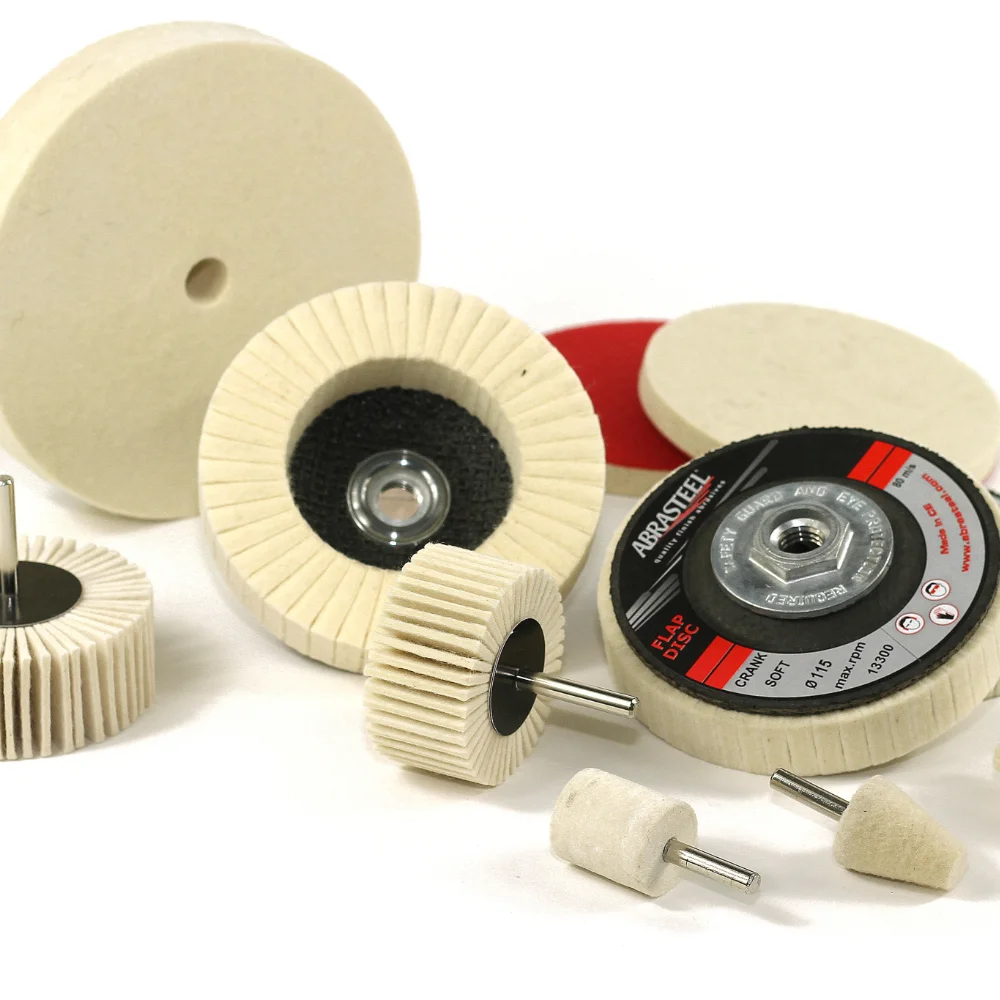
String, cotton and felt discs
For the bright finishing step on one-off pieces, ironmongery and entrance details.
For work with a hook-and-loop backing on flat and curved surfaces there are the hook-and-loop discs, and for the final buffing step, the polishing compounds. To complete the on-site process from cutting to grinding, you can also review those two families, and check the technical catalogue for the formats and diameters available.
Abrasteel as a technical supplier for construction
At Abrasteel we work with metalwork firms, architectural metalwork workshops and steel structure companies that finish exposed elements on site every day. We know that in this sector the technical conversation starts not with the product but with the element: what part it is, whether people touch it, whether it is painted or left on show and at what point in the project it will be polished.
From there we match the consumable to the real work area, not to an ideal workshop scenario. These are the points we usually review with anyone who consults us about a finishing job in construction:
- We define separate references for stainless and carbon steel to avoid cross-contamination on exposed balustrades and handrails.
- We adjust the finishing sequence to the grade the project requires: directional satin, uniform matt or bright on one-off pieces.
- We distinguish exposed polishing from preparation before painting or galvanising, where the aim is to even out the surface without burnishing it.
- We propose small formats and flexible backings for junctions, tube radii and areas where the part is already anchored.
- We ensure stock of the chosen references throughout the project, including touch-ups after handover.
If you have a project with exposed metal elements and want to settle the finish criterion before taking the material up to the floor, you can write to us from the contact page and we will review it with your specific case in front of us.
Frequently Asked Questions (FAQs)
Is it better to polish the balustrade in the workshop or once installed on site?
The usual approach is to polish as much as possible in the workshop and leave only the touch-up of the site joints for the building. If the section is welded on site, the final finish has to be done there, making sure the direction of the satin finish matches the rest of the part so the joint does not show.
Do you need to polish a section that will later be painted or galvanised?
It is prepared, but the aim is not to leave it smooth. The goal is to remove spatter, slag and sharp edges and leave an even roughness that lets the coating key in. Over-polishing these elements reduces the mechanical adhesion of the paint and can bring forward the failure of the protection system.
Why do rust spots appear on newly handed-over outdoor stainless?
Almost always because of contamination with carbon steel particles during finishing, from sharing consumables or tools between materials in the same work area. Those particles rust with moisture and show up as surface spots. The way to avoid it is to keep consumables dedicated exclusively to stainless.
What is the difference between this guide and the one on polishing in metal fabrication?
This guide covers the construction sector: elements on show, working with the part installed, coordination with other trades and preparation before painting or galvanising. For the product criteria of the family, such as disc types, backings and grit sequence, the reference is our guide to polishing in metal fabrication.
How do you match the finish at a welded handrail joint?
First the bead is ground down to the level of the tube, and only then is the finish worked, following the same direction as the satin finish on the rest of the part. It pays to extend the touch-up beyond the welded area to blend the transition, rather than stopping exactly where the joint ends.
Is grinding the same as polishing on a site balustrade?
No. Grinding removes material and takes down the bead or burr; polishing works the surface that will be on show and defines the final texture. They are successive stages: if grinding leaves deep marks, polishing does not hide them, and the defect shows even more once the shine around it is evened out.
Abrasteel advice
Exposed metal finishing on site?
We help you set the finish before the material goes up.
Contact us
Leave us your details and one of our sales representatives will contact you shortly.