
Flap Discs for Aeronautics in 2026
Abrasive discs
Technical guide to choosing flap discs for aeronautics: blending TIG welds on stainless, titanium and Inconel, breaking edges on machined aluminium parts, dressing clad sheet without cutting through the cladding, and finishing tooling and ground support equipment.
These are the 7 criteria we recommend reviewing:
- Flight part, tooling or ground equipment: three levels of requirement
- Alloy and surface condition: cladding, anodising or primer
- Grit and abrasive type for aluminium, titanium, stainless or Inconel
- Blending the weld: a step-free transition and the direction of the scratch pattern
- Edge breaking and deburring on machined parts
- Heat and discolouration on titanium, stainless and heat-treated aluminium
- Subsequent inspection and metal dust at the workstation
In an aerospace shop the flap disc comes in after welding or machining and before inspection. It blends the TIG weld on a stainless duct, breaks the edge of a freshly milled aluminium fitting or evens out the weld toe on a titanium bracket. Choosing the right flap discs for aeronautics decides whether that part reaches quality with the transition the drawing calls for, or goes back to the bench.
What sets this sector apart is not the machine but everything around the part: sheet with very thin protective coatings, heat-sensitive alloys, welds that work in fatigue and a downstream inspection that forgives neither marks nor discolouration.
Poor dressing has concrete costs. One pass too many cuts through the cladding on a 2024 sheet; a transverse scratch at the weld toe stays there as a notch; a disc that has touched steel leaves embedded particles in stainless. Below are the seven criteria we apply, how they change by part type and the mistakes we see most often.
This guide covers dressing and intermediate finishing with a flap disc. Cutting sheet, sections and tube is covered in cutting discs for aeronautics; removing heavy burr and excess material after machining or welding, in grinding discs for aeronautics; and polishing and buffing visible surfaces, in polishing discs for aeronautics. For an overview of abrasive families in the sector, the reference is abrasives in aeronautics.
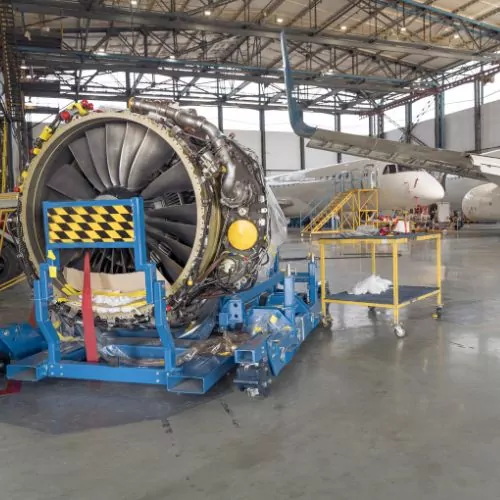
7 criteria for choosing flap discs in aeronautics
1. Flight part, tooling or ground equipment: three levels of requirement
In a shop working for the aerospace sector, the flap disc goes over very different parts in the same week. There are flight parts (brackets, ducts, welded components), tooling (steel jigs and fixtures that never fly but set the geometry of what does) and ground support equipment, such as engine stands or access platforms.
For each group the dressing has a different aim. On tooling you want a clean weld with no edges that cut the operator; on a flight part, a controlled transition that respects the drawing and the subsequent inspection. And consumables from one group never cross over to the other.
2. Alloy and surface condition: cladding, anodising or primer
A lot of aerospace sheet in 2024 or 7075 aluminium comes clad with a thin layer of high-purity aluminium (the well-known Alclad), which protects the alloy against corrosion. That layer is thin: one pass with a medium-grit flap disc goes through it without the operator noticing and leaves the base alloy exposed. The same happens with an anodised layer.
So the first question about a sheet is not which grit to use, but whether it may be dressed at all and how far. If the work instruction does not allow it, the flap disc is not the tool; if it does, the dressed area will then need the protection specified by the drawing or the applicable manual.
3. Grit and abrasive type for aluminium, titanium, stainless or Inconel
Each material punishes the flap in its own way. Aluminium loads it: metal packs between the grains and the disc goes from cutting to rubbing. Titanium and Inconel, by contrast, wear it quickly and concentrate heat in the contact zone. With stainless the problem is different: contamination with steel particles.
In practice we recommend 60 or 80 grit to blend welds and 120 to leave the transition ready, with light pressure and short passes. On titanium, stainless and Inconel a ceramic flap usually performs better because it cuts with less pressure; on aluminium, a reference kept for that metal only and, if it loads, an anti-loading compound such as tallow paste, designed to extend abrasive life on non-ferrous metals.
4. Blending the weld: a step-free transition and the direction of the scratch pattern
On a flight part the weld is almost never left as it comes off the torch, but it is not ground flush for the sake of it either. What is required is a smooth transition between weld and base metal, with no steps or undercut at the toe, because any notch concentrates stress in a part that will work in fatigue. How much is taken down is set by the drawing, not by the operator.
The direction of the scratch pattern matters too. The marks a flap disc leaves are micro-grooves, and a scratch running across the load direction behaves like a small notch. Whenever the geometry allows, finish with a fine grit along the length of the part.
5. Edge breaking and deburring on machined parts
Aluminium or titanium parts coming off the milling machine have burrs on edges and holes, and the drawing usually states how the edge must be left: broken, chamfered or with a small radius. The flap disc is suited to accessible outer edges, with a short pass and the disc held almost flat.
The risk is overdoing it. One chamfer too many on a part with a tight tolerance takes it out of drawing, and it is found at dimensional inspection. On small parts or parts with radii, it is better to drop to 115 mm or to gentler surface conditioning abrasives.
6. Heat and discolouration on titanium, stainless and heat-treated aluminium
Dressing with a flap disc generates less heat than grinding, but it still generates heat, and in this sector heat has consequences. On titanium and stainless it shows as discolouration of the surface, straw or blue; on heat-treated aluminium alloys such as 7075, local heating can affect the temper of the alloy without leaving any visible mark.
Discolouration after dressing shows that pressure or contact time has been excessive, and in many specifications it is grounds for rejection. Keep the disc moving, change the disc when it stops cutting and let small parts cool between passes.
7. Subsequent inspection and metal dust at the workstation
Many welded or machined parts go through penetrant testing or another non-destructive test after dressing. On soft metals such as aluminium, the abrasive can smear metal over a fine crack and close it, so the test does not detect it. That is why quality usually requires a prior etch or sets the order of operations.
Dust is the other front. Aluminium and titanium fines are combustible, and mixing aluminium dust with sparks or steel scale in the same extractor increases the risk. Separate workstations by material and extract at source. Flap discs are coated abrasives and their safety standard is EN 13743: respect the maximum speed marked on the disc.
Applications and technical table by part type
With flap discs for aeronautics, the choice is better organised by part type than by material, because the same alloy calls for different dressing depending on whether it is clad sheet, a machined fitting or a welded duct.
The table summarises the most common situations in the shop, the constraint that dominates and what the disc must deliver.
| Part and situation | Main constraint | What the flap disc delivers |
|---|---|---|
| TIG weld on a stainless duct or bracket | Ferritic contamination and heat discolouration. | Flap disc dedicated to stainless, 80-120 grit and a smooth, step-free transition. |
| Titanium or Inconel weld on an engine or exhaust part | Rapid abrasive wear and concentrated heat. | Ceramic flap, light pressure and short passes with the disc kept moving. |
| Edge of a machined 7075 fitting | Tight tolerance and an edge specified on the drawing. | Edge breaking with a short pass, no extra chamfer. |
| Clad 2024 sheet in a repair | Very thin protective layer that must not be cut through. | Only where the instruction allows it, with fine grit and minimal removal. |
| Welded steel tooling and ground equipment | Sharp edges and spatter on large surfaces. | Fast weld blending with 60 grit, using discs that never go back to the flight-part area. |
Welded stainless, titanium and Inconel parts
Air ducts, brackets, flanges and hot-section components are almost always TIG welded, and the weld comes out narrow with little reinforcement. If it arrives clean, the flap disc leaves the weld toe free of steps and the scratch pattern uniform; if not, grinding comes first.
The sequence we recommend is 80 grit for the transition and 120 to finish, always along the part. On titanium, check the colour of the area after every pass; on stainless, use discs that have never touched carbon steel.
Edge breaking on machined aluminium parts
Aluminium fittings and frames come off the milling machine with burrs all round the contour. The flap disc breaks the outer edge and leaves it even, without touching the toleranced faces.
In this work aluminium loads the flap almost straight away. Use a disc kept for aluminium only, apply anti-loading compound if needed and change it as soon as it stops cutting. For inner edges or small radii, surface conditioning discs remove less material and leave a finer finish.
Tooling, assembly jigs and ground equipment
Assembly jigs, engine stands and fixture beds are sizeable welded steel structures. The dressing is boilermaking work: remove spatter and leave edges that do not cut.
The condition is that those discs never end up in the area where flight aluminium, titanium or stainless is worked. Keep a set for tooling, marked and stored separately.
Common mistakes when dressing with flap discs in aeronautics
The mistake we see most is treating the flap disc as a generic consumable in a shop where every part has a drawing, a material specification and an inspection behind it.
Cutting through the cladding or anodising on an aluminium sheet
The Alclad layer or the anodising is hard to tell apart while dressing, and one pass with 60 grit removes it in seconds. The base alloy is left unprotected exactly in the area worked. Confirm beforehand whether the sheet may be dressed and, if so, work with fine grit and minimal pressure.
Leaving transverse scratches at the weld toe
Finishing with a coarse grit or with crossed passes leaves grooves perpendicular to the load, which act as notches on a part in fatigue. Always finish with fine grit and in the longitudinal direction of the part.
Using on flight parts the disc that has worked on tooling
A disc that has blended a steel weld on a jig carries particles that become embedded in aluminium, stainless or titanium. Even if it looks clean, it must not change area.
Dressing without coordinating with penetrant inspection
Dressing an aluminium weld just before the test, without the prior etch that quality requires, can hide a crack. The order is set by the part specification.
Abrasteel flap discs for aeronautics

CERAMIC flap disc
Ceramic abrasive for stainless steel and ferrous metals, in 40, 60 and 80 grit and 115 or 125 mm diameters.

HYBRID flap disc
Combines ceramic and surface conditioning flaps to grind and satin finish in one step, from EXTRA C 80 grit to V. FINE 220 grit.

ZAFIR flap disc
For all kinds of metals, with a fibreglass backing and 40, 60, 80 and 120 grit, useful for dedicating a set to each material.

TURBO INOX flap disc
Dedicated to stainless steel, with an M14 hub that mounts without a nut, for flat surfaces.
The full range is in Abrasteel flap discs. For aluminium, tallow paste helps the flap take longer to load, and the technical catalogue lists grits, diameters and maximum speeds for the whole family. For the general criteria of the family, see abrasive flap discs and, for weld dressing in general, flap discs for welding.
Abrasteel as a technical supplier for aeronautics
At Abrasteel we work with machining, precision fabrication and maintenance shops that serve the aerospace sector. We know the conversation does not start with the disc but with the part: what alloy it is, whether it is clad or anodised, what the drawing says about the edge and the weld, and what inspection comes next.
- We help define a short set of grits per material, with separate discs for aluminium, stainless, titanium and steel tooling.
- We provide the technical data sheet for each reference and the batch data for what we supply, for your traceability records.
- We review with you where the flap disc fits and where it is better to move to surface conditioning so as not to remove too much.
- We keep the same references over time, so you do not have to change consumable in a process that is already validated.
If your shop dresses aerospace parts and you want to review which flap discs for aeronautics to keep at each workstation, you can write to us from the contact page and we will go through it with your drawings and materials in front of us. Approval of the consumable within your process is the responsibility of your quality system and, where it requires it, your customer; we give you the technical information to carry it out.
The complementary operation, removing burr and excess material before dressing with flap discs, is covered in grinding discs for aeronautics.
Frequently Asked Questions (FAQs)
What is the difference between this guide and the one on grinding discs for aeronautics?
The grinding guide covers removing heavy burr and excess material after machining or welding. This one covers the next step: blending the weld toe, breaking edges and leaving the surface with the scratch pattern and transition the drawing calls for before inspection.
Can clad aluminium sheet be dressed with a flap disc?
Only if the work instruction or the applicable manual allows it, because the pure aluminium layer that protects the alloy is very thin and one pass with a medium grit goes through it. If it is allowed, use fine grit and minimal pressure, and then apply the specified protection.
Which flap disc grit suits TIG welds on stainless or titanium?
For most TIG welds, 80 grit for the transition and 120 to finish is enough, with the disc kept moving and short passes. If the weld comes with a lot of reinforcement, grind first.
Why should the last pass run along the part?
Because abrasive marks are small grooves and, if they are left perpendicular to the load, they act as notches on a part working in fatigue. Finishing lengthwise with a fine grit leaves shallow, well-oriented grooves.
What do I do if the flap disc loads up on aluminium?
Change it as soon as it stops cutting, rather than pressing harder. An anti-loading compound such as tallow paste extends abrasive life on non-ferrous metals, and it is worth keeping discs for aluminium only.
Can I use the same discs on tooling and on flight parts?
It is not recommended. A disc that has worked on steel carries particles that become embedded in aluminium, stainless or titanium. The practical approach is to have one identified set for tooling and another for each flight-part material.
Abrasteel advice
Dressing welds and edges on aerospace parts?
We help you separate discs and grits by material and by part.
Contact us
Leave us your details and one of our sales representatives will contact you shortly.