
9 uses of silicon carbide in surface treatment in 2026
Finishing and polishing
Technical guide to silicon carbide surface treatment for blasting, sanding, grinding wheels and finishing on hard, brittle or heat-sensitive materials.
These are the 9 uses of silicon carbide in surface treatment Abrasteel recommends reviewing:
- Abrasive blasting and surface stripping
- Sanding hard materials
- Glass, stone and ceramic treatment
- Custom grinding wheels
- Preparation before coatings
- Deburring non-ferrous parts
- Finishing fragile parts
- Technical polishing sequences
- Processes where abrasive purity matters
Silicon carbide is a hard, sharp and friable abrasive. It is used when a process needs fast attack, sharp cutting edges and control on hard, brittle or non-ferrous materials. It is not a universal abrasive for every part, but it can be highly effective when type, grit and application method are selected correctly.
In surface treatment, performance depends on both the abrasive material and the process. Poorly selected silicon carbide can create excessive roughness, high consumption, unnecessary dust or an irregular finish. The right grain size helps achieve bite, cleanliness and repeatability.
At Abrasteel, we recommend analysing the operation first: blasting, wheel grinding, sanding, deburring or finishing. The material must also be reviewed: glass, stone, ceramics, cast iron, aluminium, carbide, titanium, composites or non-ferrous metals. Each material reacts differently to grain impact or friction.
This guide explains the main uses of silicon carbide, the difference between black and green grades, grit selection criteria and common mistakes that can increase process cost.
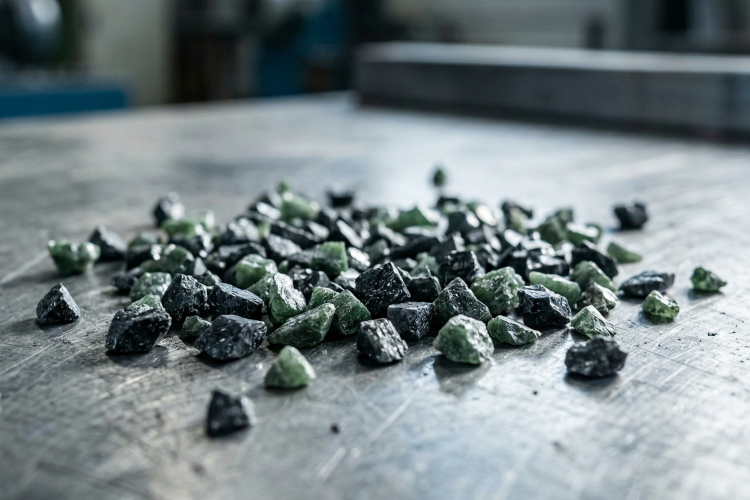
9 uses of silicon carbide in surface treatment
1. Abrasive blasting and surface stripping
In blasting, silicon carbide is used when the process needs an aggressive abrasive to remove coatings, hard oxides or surface contamination. Its hardness helps create a suitable anchor profile before painting or coating, provided that pressure, distance, angle and grit are controlled.
For this use, define the roughness target before buying. If the profile is too open, coating consumption increases and additional cleaning may be required. If it is too smooth, adhesion may not be sufficient. Grit should be selected with that technical target in mind.
2. Sanding hard materials
Its cutting ability makes silicon carbide useful when other grains load or lose sharpness too quickly. It can be used on hard or sensitive surfaces, but backing and grit selection are critical to avoid marks that are too deep for the next stage.
On hard materials, the goal is not only to cut fast. The process must keep the workpiece under control: heat, edge chipping, dust and finish uniformity must be considered before choosing a grit.
3. Glass, stone and ceramic treatment
On mineral or brittle materials, silicon carbide provides sharp edges capable of working difficult surfaces. Temperature, pressure and grit progression must be controlled to avoid breakage, chipping or irregular finish.
The same abrasive can behave very differently on a rigid stone surface, a ceramic component or a glass edge. The more fragile the part, the more important it is to test pressure, angle and progression before moving to full production.
4. Custom grinding wheels
Silicon carbide is used in grinding wheels when the process needs to work hard, non-ferrous or specific-behaviour materials. The combination of grain, bond, hardness and porosity affects the final result more than the abrasive material alone.
When a wheel is specified for an industrial process, the question is not simply “black or green silicon carbide”. Diameter, thickness, bore, speed, bond, hardness, cooling and tolerance all influence performance and safety.
5. Preparation before coatings
When adhesion matters, silicon carbide can create an active and rough surface. The key is not to overdo it. Too much aggressiveness can create peaks, valleys or abrasive dust that forces another cleaning step before coating.
In steel surface preparation, the required cleanliness and profile often depend on the coating system and project specification. International references such as ISO 8501-1 help frame surface preparation grades, but the final requirement should come from the coating specification.
6. Deburring non-ferrous parts
On aluminium, bronze, brass and other non-ferrous alloys, silicon carbide can help remove burrs or prepare edges. Loading must be monitored, and the abrasive sequence should avoid overheating or charging the surface.
If the part is soft, the process may need anti-loading strategies, lower pressure, coolant, open coating or a different abrasive family. The right choice depends on the alloy and on the finish expected after deburring.
7. Finishing fragile parts
On fragile parts, silicon carbide’s sharpness can be an advantage or a risk. It is useful with fine grits and controlled pressure, but it can be too aggressive if applied like a general workshop abrasive.
This is why abrasive testing should include the whole sequence. A fast first pass that leaves micro-chipping or deep marks may create more work in the polishing stage than it saves in the initial stage.
8. Technical polishing sequences
Silicon carbide can be part of a preparation sequence before polishing. In that case, each stage should reduce the marks from the previous one. Skipping too many grits increases working time and leaves defects visible in the final finish.
When the final target is visual quality, the abrasive should be selected backwards from the finish. The question is not only which grain removes material, but which grain leaves the surface ready for the next compound, felt, cloth or brush stage.
9. Processes where abrasive purity matters
In some applications, grain purity and classification are as important as hardness. An irregular distribution can cause uneven finishes, excessive consumption or results that are difficult to repeat from batch to batch.
For recurring industrial use, define acceptance criteria: particle size, surface profile, visual appearance, consumption per lot and rejection rate. That turns the abrasive from a generic material into a controlled process variable.
What buyers need from silicon carbide
A buyer searching for silicon carbide usually wants to know what it is used for, the difference between black and green grades, which grit to choose and whether it is suitable for their material. They are not looking only for a chemical definition; they need a practical decision for a workshop, blasting cabinet or finishing process.
The intent combines technical information and B2B purchasing. The user wants to avoid grit mistakes, reduce quality rejects and choose an abrasive that can be supplied consistently when the process is recurrent.
Technical need: choose type, grit and process to cut, clean or finish without damaging the workpiece.
Purchasing need: compare black silicon carbide, green silicon carbide, wheels or blasting abrasive with advice and stable supply.
Black or green silicon carbide
Black silicon carbide is often used as an industrial option for cleaning, wear and preparation applications where aggressiveness and cost balance are required. It is common in processes where the part can accept a strong abrasive action and productivity matters.
Green silicon carbide is associated with higher purity and more demanding applications. It can make sense in precision work, hard materials or processes where contamination and grain regularity are especially important.
The decision should not be based on colour alone. Consider material, target roughness, pressure, equipment, abrasive recovery and cleaning after the process. Sometimes the problem is not the type of silicon carbide, but a grit that is too coarse or pressure that is poorly adjusted.
In blasting, it is also important to check whether the abrasive is recovered and reused. A well-classified abrasive may behave more consistently over several cycles, but if extraction, separation or cleaning is not adjusted properly, fines and broken particles change the real surface profile.
In grinding wheels and abrasive tools, colour is also not enough to define the specification. Final performance depends on bond, hardness, structure, porosity, grit and working speed. When the process has tolerances or industrial repetition, document the full specification and avoid ordering only “silicon carbide”.
Selection table by grit and application
| Objective | Indicative type | Advantage | Precaution |
|---|---|---|---|
| Intense stripping | Black silicon carbide, coarser grit | High attack capacity. | Control roughness and post-cleaning. |
| Controlled finishing | Medium or fine grit | Less marking and better regularity. | Do not skip too many grit stages. |
| Precision or purity | Green silicon carbide | Greater control in demanding applications. | Confirm that it pays back against the cost. |
| Custom wheels | According to bond and hardness | Adapted to process and material. | Do not define only the abrasive; the full wheel specification is needed. |
Related Abrasteel products to compare

Black silicon carbide
Option for industrial cleaning, wear and preparation processes where high cutting capacity is needed.

Green silicon carbide
Alternative for higher-purity or higher-precision applications where grain consistency matters.

Custom grinding wheels
Product family for defining grain, bond, hardness and format when repeatability is required.
Common mistakes when using silicon carbide
Choosing a grit that is too aggressive
A coarse grit cleans quickly, but it can also leave excessive roughness. If coating, visible finishing or polishing follows, define the roughness target before choosing the abrasive.
Not controlling pressure and distance
In blasting, poorly adjusted pressure changes the result completely. It can increase consumption, create dust, deform thin parts or produce an irregular profile. The right abrasive needs a controlled process.
Comparing only by price per kilogram
Real cost depends on consumption, reuse, working speed, post-cleaning and quality rejects. A poorly classified abrasive can be expensive even when its unit price is low.
Not cleaning the part after the process
After blasting or sanding, abrasive dust may remain on the surface. If paint, coating or polishing is applied without adequate cleaning, adhesion or finish defects can appear.
Safety, dust and process control
Using abrasives in blasting, sanding or grinding wheels can generate dust, projected particles, noise and respiratory exposure. Cabinets, extraction, filtration and protective equipment must match the actual process, not only the abrasive material.
Before working, review the technical data sheet, equipment compatibility, storage and use conditions. The NIOSH abrasive blasting guidance, the OSHA information on respirable crystalline silica and the FEPA abrasive safety publications are useful references for reinforcing internal procedures.
When working with loose abrasive, workplace cleanliness also matters. Grain remaining on the part, table or cabinet can contaminate later painting, coating or polishing stages. Good abrasive selection loses value if the process does not remove dust and residue before the next operation.
In recurring processes, documenting pressure, grit, consumption and result makes it easier to repeat quality and reduce variation between shifts, batches or suppliers.
Abrasteel as a silicon carbide supplier
Abrasteel works with silicon carbide solutions for industrial applications, including options related to grinding wheels, surface treatment and processes where grain consistency matters.
When a customer asks about an application, we do not look only at the abrasive name. We review equipment, material, tolerances, finish, consumption, abrasive recovery and post-cleaning. That broader view helps improve selection and avoid supplier changes that alter the result.
If the process is part of a production line, it is also useful to define acceptance criteria: roughness, visual appearance, working speed, consumption per lot and rejection rate. With those data points, silicon carbide selection becomes a controlled decision rather than an isolated trial.
You can review Abrasteel’s custom grinding wheel family and the references for black silicon carbide and green silicon carbide. If the process is critical, we recommend sharing material, target roughness, equipment and approximate consumption.
Do you need to define silicon carbide type and grit? Tell us the material, process and expected result so Abrasteel can guide the selection.
Frequently Asked Questions (FAQs)
What is silicon carbide?
Silicon carbide is a hard, sharp and friable abrasive. In surface treatment it is used for its ability to cut, clean and create roughness on hard, brittle or non-ferrous materials. Its performance depends on type, grit and process control.
What is silicon carbide used for?
It is used in blasting, sanding, grinding wheels, surface preparation, deburring, glass, stone and ceramic finishing, and processes that need a hard abrasive with sharp cutting edges. Not every process requires the same grit.
What is the difference between black and green silicon carbide?
Black silicon carbide is often used in general industrial applications for its balance between aggressiveness and cost. Green silicon carbide is associated with higher purity and more demanding processes. The choice depends on material, finish, equipment and process tolerance.
Is silicon carbide suitable for stainless steel?
It can be used in some operations, but it is not always the first choice. On stainless steel, contamination, heat and finish must be controlled carefully. For cutting, grinding or finishing stainless steel, other abrasive families may be more suitable depending on the operation.
How do I choose the right grit?
Define the objective first: removing material, cleaning, creating roughness or preparing a finish. Coarser grits attack faster but leave more marks. Finer grits offer more control but may work more slowly. The grit sequence is critical.
What information should I send for advice?
Share material, process, equipment, pressure or speed, target roughness, current grit and the problem you want to solve. If consumption is recurrent, add approximate volume. That information makes it easier to evaluate type and grain size.
Abrasteel advice
Black, green or custom wheel?
Send us material, equipment and target roughness, or download the full catalogue.
Contact us
Leave us your details and one of our sales representatives will contact you shortly.