
7 Types of Abrasive Sanding Brush for Metal in 2026
Abrasive brushes
Technical guide to choosing the right abrasive sanding brush for the material, operation and machine: non-woven, abrasive cloth, zirconia, shaft-mounted and satin finishing machine.
These are the 7 types of abrasive sanding brush we recommend reviewing:
- Non-woven brush with core
- Non-woven and abrasive cloth brush with core
- Brush with zirconia core
- Brush with pre-cut cloth core
- Shaft-mounted brush for drills and grinders
- Sanding brush for industrial satin finishing machines
- Sanding brush with abrasive strips or flaps
For cleaning, matting, satin finishing, deburring or preparing metal surfaces, the abrasive sanding brush is the dedicated tool for working on metal. It is not a sealing or barrier element: it is an abrasive consumable that acts directly on the surface to remove residues, strip rust, condition the part or produce a controlled technical finish. Choosing the right type changes the result, the wear and the cost per operation.
At Abrasteel we work with distributors, workshops, industrial maintenance, boilermaking and steel construction. What we often see is that selection mistakes do not come from a lack of product knowledge, but from choosing by size without checking fibre, mineral, backing and compatibility with the machine. A sanding brush with the wrong grit for stainless steel can leave marks that are hard to recover. One that is too soft on rusty steel forces repeat passes and multiplies the operating time.
In this guide we explain the 7 main types of abrasive sanding brush for metal, how to choose by material and operation, which technical parameters to check before ordering and which common mistakes to avoid in industrial B2B environments.
The right decision affects finish quality, consumable life, operator safety and cost per part processed. In recurring industrial purchasing, standardising the right brush from the outset avoids rework, rejects and reference changes in production.
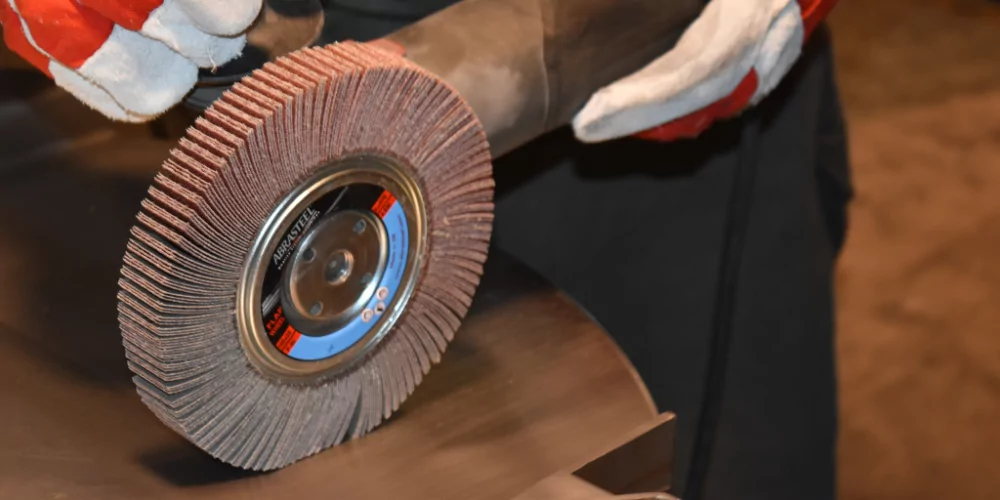
7 types of abrasive sanding brush for metal
1. Non-woven brush with core
This is the most common format for matting, satin finishing and controlled conditioning of metal surfaces, especially visible stainless steel. The nylon fibre impregnated with abrasive mineral gives uniform, progressive contact: as the fibre wears, it exposes a fresh abrasive layer, which keeps the finish consistent throughout the life of the brush.
The core defines the mounting: it must be compatible with the satin finishing machine, the bench or the finishing machine. Before ordering, confirm the outside diameter, working width, core diameter and maximum operating speed. It is the first reference to look at when the goal is an even, repeatable finish without uncontrolled directional marks.
2. Non-woven and abrasive cloth brush with core
It combines layers of non-woven material with interleaved abrasive cloth strips. The cloth makes it more aggressive than pure non-woven, so this format is better suited to heavy abrasive cleaning, surface preparation and removal of process residues.
On carbon steel with moderate surface rust or weld residue, this combination removes more material than non-woven alone, with more control than a wire brush. Working pressure needs checking: too much pressure shortens service life and can leave marks on surfaces that need a later finish.
3. Brush with zirconia core
Zirconia gives greater aggressiveness and better performance than standard aluminium oxide in heavy work on carbon steel, steel structures or parts with stubborn residues. It is recommended for operations that need more stock removal per pass: heavy rust removal, cleaning before welding and surface preparation in industrial maintenance.
Because it is more aggressive, using it on stainless steel calls for particular care: it can leave deeper marks if pressure and speed are not well controlled. On visible stainless steel with a demanding finish, non-woven or standard abrasive cloth usually gives a more controllable result. The zirconia core is the right reference when what matters is performance and cleaning speed on carbon steel or oxidised materials.
4. Brush with pre-cut cloth core
The abrasive cloth strips are cut radially and mounted on the core, creating a brush with greater lateral flexibility and ability to adapt to irregular shapes. It is the option to choose when the surface has radii, profiles, weld beads, transition zones or irregularities that a rigid core struggles to cover.
The finish may be slightly less even than compact non-woven, but coverage of hard-to-reach areas is clearly better. Very useful in boilermaking, steel construction and maintenance of parts with variable geometry.
5. Shaft-mounted brush for drills and grinders
A smaller, easier-to-handle format: it works with a portable tool, drill or grinder. It is the right solution for details, narrow areas, the inside of profiles, isolated weld beads, burrs on individual parts or hard-to-reach areas that a satin finishing machine or bench cannot get to.
The working width is smaller than the core formats, but manoeuvrability is its main advantage. It is available in non-woven, abrasive cloth and other fibres depending on the aggressiveness required. In industrial purchasing, it pays to have the right reference identified for each specific application so that the wrong tool is not used for detail work.
6. Sanding brush for industrial satin finishing machines
Designed specifically for belt or brush satin finishing machines. It gives an even finish on stainless steel sheet, large-surface parts, series production or any job where consistency between parts is critical.
The essential condition is that dimensions and core are compatible with the satin finishing machine: outside diameter, width, bore and working speed. A correctly selected and adjusted satin finishing brush gives the most uniform result in the whole range. It needs an initial test on a controlled area to adjust pressure, speed and number of passes before standardising it in production.
7. Sanding brush with abrasive strips or flaps
A format with abrasive strips or flaps mounted on a core or flexible backing. It offers more lateral adaptability than compact non-woven models, which makes it useful for profiles, tubes, curved parts or shapes that a rigid core does not cover well along their whole length.
Suitable for sanding, light deburring and surface preparation where the fibre adapting to the shape of the part is the priority. For visible finishing on stainless steel, non-woven remains more predictable; strips or flaps have the edge on parts with variable geometry or mixed areas.
How to choose by material and operation
The right choice always starts from the material to be worked and the expected result, not from the size. Two brushes with the same diameter and width can behave completely differently depending on fibre, abrasive mineral, density and construction.
| Material | Operation | Recommended brush | Technical note |
|---|---|---|---|
| Visible stainless steel | Satin finishing / matting | Non-woven with core | Control grit, pressure and direction of pass. Avoid cross-contamination with carbon steel. |
| Stainless steel | Abrasive cleaning / preparation | Non-woven and abrasive cloth with core | More aggressive. Use consumables dedicated to stainless steel; do not mix with tools that have worked carbon steel. |
| Rusty carbon steel | Heavy cleaning / preparation | Zirconia core | More stock removal per pass. Check RPM and machine compatibility before use. |
| Profiles, tubes, radii | Cleaning / finishing of irregular shapes | Pre-cut cloth or abrasive strips | Greater lateral adaptability. The finish is slightly less even than compact non-woven. |
| Any metal | Burrs, details, narrow areas | Shaft-mounted brush (drill / grinder) | Portable tool. Smaller working width but maximum manoeuvrability. |
| Stainless steel / metal in series | Even finish on large surfaces | Brush for industrial satin finishing machine | Most uniform result in the whole range. Core and dimensional compatibility with the machine must be checked. |
What buyers of an abrasive sanding brush are looking for
Anyone looking for an abrasive sanding brush in an industrial context usually has a specific problem on the metal: rust to remove, weld residue, a surface to prepare before treatment, stainless steel to satin finish or a finish to standardise in production. The purchase intent is technical and results-driven, not driven by unit price.
Cleaning and surface preparation: remove rust, residues, surface contamination or process remains before treatment, painting, welding or finishing.
Matting and satin finishing: produce an even, technical finish on visible stainless steel, sheet, industrial furniture parts, architectural metalwork or catering equipment.
Deburring and finishing: remove cutting or machining burrs, soften sharp edges and prepare the part for assembly or delivery.
The usual difficulty is not finding a brush, but identifying which type best handles each operation. At Abrasteel we help separate needs: not every brush that looks similar works the same way on the same material. Mineral, fibre, density and backing shape the result as much as the size.
Technical parameters to check before choosing
Before ordering an abrasive sanding brush for industrial use, it is worth defining these data. The more complete the information, the easier it is to choose the right reference from the first order.
- Material to be worked: stainless steel, carbon steel, aluminium, iron, painted surface or other.
- Operation: cleaning, satin finishing, matting, deburring, surface preparation or visible finish.
- Machine and mounting: satin finishing machine, workbench, drill, grinder or specific tool. Confirm core diameter, keyway or adaptor.
- Dimensions: outside diameter, working width and core bore.
- Working speed: machine RPM, to check compatibility with the brush.
- Expected finish: matt, satin, even, or just technical cleaning with no aesthetic requirement.
- Consumption and frequency: number of parts per shift, estimated brush change and need for recurring stock.
In visible finishing applications, testing on a real part before standardising in production is essential. Two brushes with the same diameter and fibre type can leave different finishes because of density, grit or mineral. When the result is critical, it is worth testing on a controlled area before approving the reference for series production.
Common mistakes when selecting abrasive sanding brushes
Choosing by size without checking fibre or mineral
Size is necessary but not enough. A 150 mm diameter non-woven brush and another of the same size in zirconia abrasive cloth behave completely differently. Fibre, mineral and density determine aggressiveness and finish, not just the dimensions.
Not keeping stainless and carbon steel consumables apart
Using the same sanding brush on carbon steel and then on stainless steel can transfer ferrous particles to the stainless surface and cause corrosion spots. On stainless steel, consumables must be dedicated to that material and must not have been used on carbon steel before.
Applying too much pressure
Excessive pressure deforms the fibre, generates heat, speeds up wear and can leave marks that are hard to recover on visible surfaces. If the brush does not do the job with reasonable pressure, the problem lies in the choice of reference, not in the force applied.
Not checking core compatibility with the machine
A brush mounted with play or off-centre causes vibration, an uneven finish and a risk of breakage. Before fitting, check that the core, bore, keyway and speed are compatible with the machine. If in doubt, ask us before installing.
Not documenting the trial before standardising
If the brush is used in recurring production, record the machine, speed, pressure, number of passes, service life and finish obtained. Without that data, recurring purchasing turns into trial and error and the real cost per operation cannot be calculated.
Abrasive sanding brushes at Abrasteel
If what you need is cleaning, satin finishing, matting or finishing on metal, these Abrasteel abrasive sanding brush families can be your reference. The final selection should be validated against machine, core, pressure, material and expected finish.

Non-woven with core
For matting, satin finishing and controlled conditioning of stainless steel and visible metal surfaces.

Non-woven and abrasive cloth with core
For abrasive cleaning and surface preparation with more aggressiveness and stable contact.
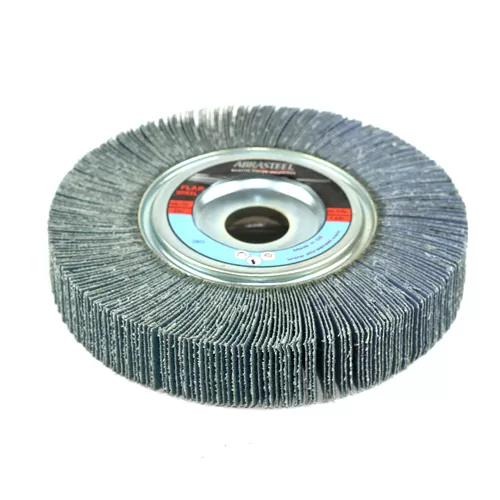
Brush with zirconia core
For heavy cleaning and aggressive work on metal where more stock removal and performance are needed.

Pre-cut cloth with core
For profiles, radii and parts with variable geometry where lateral adaptation is key.
To compare the whole range, you can start from the brushes with core family. If the job is detail work or with a portable tool, look at the shaft-mounted brushes. If the goal is series finishing with a satin finishing machine, the brushes for satin finishing machines family is the right reference.
Abrasteel as a technical supplier of abrasive brushes
At Abrasteel we supply abrasive sanding brushes for metal, stainless steel, industrial maintenance, boilermaking and steel construction. The approach is not a generic catalogue: we help identify which type of brush handles each operation according to material, machine, expected finish and planned consumption.
- For satin finishing and matting stainless steel: non-woven with core, with control of grit and working direction.
- For heavy cleaning of carbon steel: abrasive cloth with core or zirconia, depending on the aggressiveness required.
- For detail work and portable tools: shaft-mounted brushes compatible with drills or grinders.
- For series production: brushes for satin finishing machines with verified core compatibility.
- For recurring purchases: a stable reference, available stock and technical support for standardising the process.
If you need to choose an abrasive sanding brush for a specific application, send us the material, machine, operation, dimensions and expected finish. We will point you to the right family and reference before you standardise the purchase.
To choose between a brush, a grinding disc or a non-woven pad depending on the part, see the comparison on how to remove rust from metal.
Frequently Asked Questions (FAQs)
What is an abrasive sanding brush?
An abrasive sanding brush is an industrial consumable that works directly on the metal surface to clean, sand, satin finish, matt, deburr or prepare it before treatment or finishing. It acts by abrasive friction on the part: it removes material, strips rust, conditions the surface or produces a controlled technical finish.
What grit should I choose in an abrasive sanding brush for stainless steel?
For fine satin finishing on visible stainless steel, the most common grits are 180 and 240. For standard matting or surface preparation, the 120–180 range usually gives good results. For more aggressive abrasive cleaning, coarser grits (80–120) work faster but leave more visible marks. Testing on a controlled area before standardising in production is always advisable when the finish is demanding.
What materials is an abrasive sanding brush used on?
Mainly stainless steel and carbon steel. On stainless steel, the non-woven brush with core is the standard format for matting and satin finishing. On carbon steel, abrasive cloth or zirconia gives more aggressiveness for cleaning and preparation. It is also used on aluminium, although you need to check that the fibre and mineral are suitable for that material.
When should I use a shaft-mounted brush and when a brush with core?
The shaft-mounted brush works with a portable tool: ideal for details, narrow areas, the inside of profiles or isolated burrs. The brush with core offers more working width and stable contact: suitable for large surfaces, satin finishing machines or repetitive processes where the finish must be even across all parts.
How do I avoid contaminating stainless steel when using abrasive sanding brushes?
Consumables that have worked carbon steel can transfer ferrous particles to stainless steel and cause corrosion spots. To avoid this, use sanding brushes dedicated to stainless steel that have never been in contact with carbon steel. Identify stainless steel consumables and keep them physically separate from those used on other materials.
What information does Abrasteel need to guide the choice?
Material of the part, operation to be carried out, machine or tool available, brush dimensions (diameter and width), machine speed, expected finish and estimated consumption volume. With that information we can point you to the right family and reference before you standardise the purchase in production.
Can Abrasteel help me choose the right brush?
Yes. Abrasteel’s technical team can guide the selection according to material, machine, operation and expected finish. If you describe the real problem — cleaning, satin finishing, matting, deburring or preparing — we can identify which family and reference fits best before you standardise the purchase in your process.
Abrasteel advice
Which brush fits your process?
Material, machine, operation and expected finish.
Contact us
Leave us your details and one of our sales representatives will contact you shortly.