
9 industrial boilermaking abrasives to review in 2026
Industrial abrasives
A BOFU guide to selecting industrial boilermaking abrasives by operation, material, machine, finish, safety and professional supply needs.
These are the 9 industrial boilermaking abrasives worth reviewing first:
- Cutting discs for plate, tube and profile
- Grinding discs for burrs, edges and weld seams
- Flap discs for blending and intermediate finishing
- Fibre discs for controlled levelling
- Abrasive brushes for cleaning and preparation
- Abrasive belts and rolls for surfaces and contours
- Clean Strip and non-woven abrasives for surface cleaning
- Mounted points, sleeves and small consumables for difficult areas
- Backing pads, adapters and accessories for stable mounting
Industrial boilermaking abrasives should be selected as part of the fabrication process, not as isolated consumables. A boilermaking shop cuts plate, prepares tube, cleans profiles, reduces weld seams, removes surface contamination and leaves parts ready for painting, assembly, passivation or visible finishing.
At Abrasteel, we usually start with material, operation, machine, pressure, expected finish, safety and recurring consumption. A cheap disc can become expensive if it wears fast, vibrates, overheats the workpiece or forces a second finishing stage. In repetitive production, cost per operation matters more than unit price.
This guide is written for professional buyers, workshop managers, distributors, maintenance teams, welders and industrial companies that need to organise abrasive purchasing with technical criteria. It does not cover general boiler shop machines: it focuses on the abrasive families that affect productivity, consistency and finish.
If you already have a problem with consumption, heat, vibration, short life or inconsistent finish, use this article to identify which abrasive family to review and what process data to share before asking for technical advice.
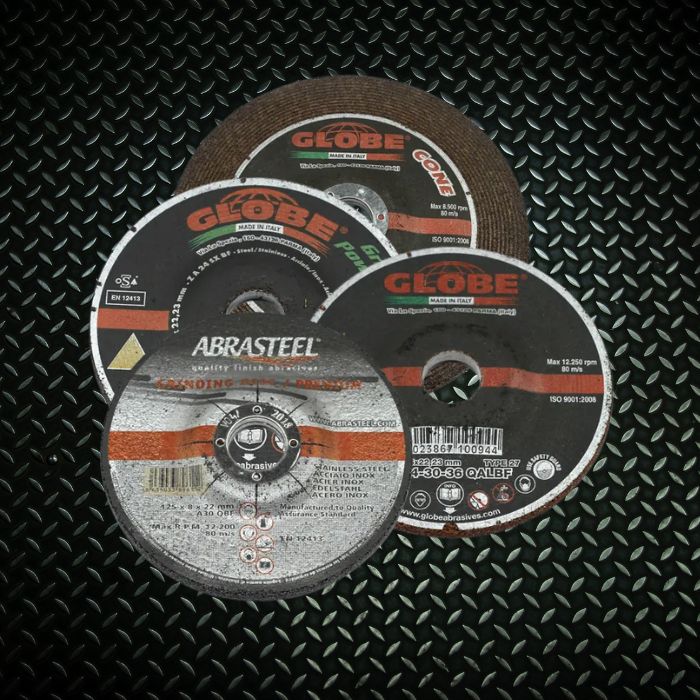
9 industrial boilermaking abrasives
1. Cutting discs for plate, tube and profile
Cutting discs are the first family to define clearly. In boilermaking they are used on plate, tube, profile, rod, metal structures and variable thickness components. The right choice changes with disc diameter, wheel thickness, material and whether the operation uses an angle grinder, chop saw or another compatible machine.
For stainless steel, avoid ferritic contamination and choose consumables suited to the material. For carbon steel, the priority may be speed and service life. If the cut leaves excessive burr, the grinding stage becomes slower and more expensive.
2. Grinding discs for burrs, edges and weld seams
Grinding discs remove material, reduce sharp edges, correct burrs and work weld seams when there is volume to take off. In heavy boilermaking, the disc must be robust, stable and suitable for lateral pressure.
They should not be confused with cutting discs. Grinding has a different construction and a different working mode. If the final surface is visible or must be ready for coating, grinding is usually followed by flap discs, fibre discs or non-woven abrasives.
3. Flap discs for blending and intermediate finishing
Flap discs are useful when the shop needs to combine stock removal, control and intermediate finish. They often come after cutting or initial grinding to soften marks, blend transitions and prepare the surface for a later stage.
Mineral and grit matter. Coarse grits accelerate removal; medium and fine grits improve control. Stainless steel or demanding work may justify ceramic options, while general carbon steel work can often use a balanced all-purpose flap disc.
4. Fibre discs for controlled levelling
Vulcanised and compressed fibre discs help level surfaces, prepare edges and work with more control than aggressive grinding. They are useful when the piece will move to painting, assembly or a more refined surface stage.
The backing pad is part of the result. A well-chosen fibre disc can perform poorly if the support does not transmit pressure evenly or if the machine is not suitable for the disc and speed.
5. Abrasive brushes for cleaning and preparation
Shaft-mounted brushes and core brushes remove rust, paint, scale, contaminants and surface residue. In industrial boilermaking they are useful when the goal is to clean without removing too much base material.
Brush shape, core, shaft and machine compatibility affect vibration and scratch pattern. Separate aggressive cleaning, preparation before coating and final surface finishing before choosing one brush for all three tasks.
6. Abrasive belts and rolls for surfaces and contours
Cloth abrasive belts fit long surfaces, tubes, tanks, contours and repetitive operations. They may work on portable or fixed machines depending on size, joint, backing and contact pressure.
For demanding grinding, ceramic aluminium oxide or zirconia can be worth reviewing. For general preparation, a well-specified aluminium oxide belt may be enough. In high consumption, measure parts per belt, operation time, finish and joint stability.
7. Clean Strip and non-woven abrasives for surface cleaning
Clean Strip discs and non-woven abrasives remove rust, paint, dirt and contamination without behaving like heavy grinding discs. They are useful in maintenance, surface preparation and recovery of components.
Their value is controlled cleaning. If the shop uses a product that is too aggressive for this stage, it may remove excess material and create marks that then need correction.
8. Mounted points, sleeves and small consumables for difficult areas
Mounted points, abrasive sleeves and small consumables are needed in corners, internal areas, holes, edges and geometries where a disc does not enter properly. In fine boilermaking, repair or maintenance they solve adjustment work without changing the whole abrasive sequence.
Safety is especially important here: speed, mounting, pressure and access to the workpiece must be controlled. A small consumable used incorrectly can create deep marks or break prematurely.
9. Backing pads, adapters and accessories for stable mounting
Accessories are not secondary. Backing pads, adapters, supports and mounting components influence vibration, safety, service life and finish. A good abrasive can perform poorly if the accessory is worn, unstable or incompatible.
For industrial purchasing, review consumables and accessories together. This prevents the shop from changing abrasive family when the real issue is the support, machine or mounting method.
What buyers need from industrial boilermaking abrasives
A buyer searching for industrial boilermaking abrasives usually does not need a basic definition. The need is practical: which families should be in stock, which product fits each stage, how to reduce consumption and who can advise when the shop works with steel, stainless steel, aluminium or recurring structural jobs.
The intent is both technical and commercial. The user needs to understand what to use, but also wants to move toward a purchase decision with stock, continuity, support and correct application data. That is why the content must organise selection criteria rather than simply list product names.
Technical need: choose the right abrasive for cutting, grinding, cleaning, sanding and finishing.
Purchasing need: reduce unproductive references, secure supply continuity and ask for advice with specific process data.
How to choose abrasives by work stage
The most practical way to buy abrasives is to start from the work stage. This avoids selecting by habit and connects each consumable with the expected result.
| Stage | Recommended abrasive | Common use | Data to provide |
|---|---|---|---|
| Cutting | Cutting discs | Plate, tube, profile and structures | Material, thickness, diameter and machine. |
| Grinding | Grinding discs | Burrs, edges, weld seams and stock removal | Material to remove, pressure and later finish. |
| Blending | Flap or fibre discs | Reducing marks and preparing surfaces | Grit, material and visual requirement. |
| Cleaning | Brushes, Clean Strip or non-woven abrasives | Rust, paint, scale and contaminants | What must be removed and how much base material can be touched. |
| Finishing | Belts, fibre, non-woven, felt or polishing | Final preparation, satin finish or visible finish | Target roughness, later treatment and material. |
B2B buying criteria for boilermaking shops
In industrial purchasing, selection does not stop at a product sheet. The abrasive must fit the real process and the supply must be sustainable. For a boilermaking shop, the most important criteria are usually these:
- Material compatibility: carbon steel, stainless steel, aluminium, cast iron or alloys.
- Machine and speed: diameter, RPM, power, support and guards.
- Cost per operation: operator time, tool changes, service life, rework and accepted parts.
- Safety: correct mounting, correct application and certified references when required.
- Supply continuity: stock, equivalent references and support for recurring purchases.
For abrasive wheel safety, purchasing should also consider machine guarding, inspection and maximum operating speed. The OSHA rules for portable abrasive wheels, the HSE abrasive wheels guidance and the FEPA safety code for bonded abrasives are useful neutral references when reviewing cutting and grinding operations.
For technical advice, prepare material, operation, machine, current consumption, detected problem and expected finish. With those data, a supplier can recommend a more stable solution.
Related Abrasteel product families
For industrial boilermaking, the main abrasive families are usually combined. You can start with the abrasive discs category and then select the specific family by operation.

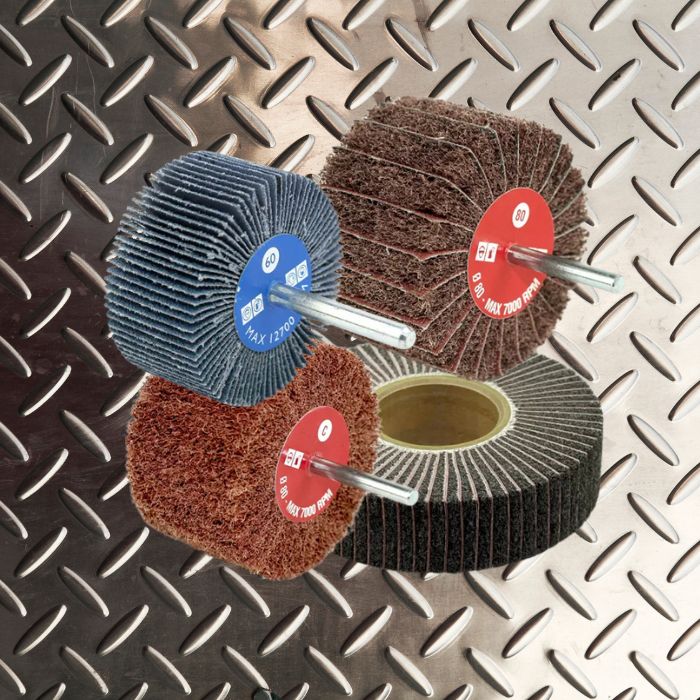
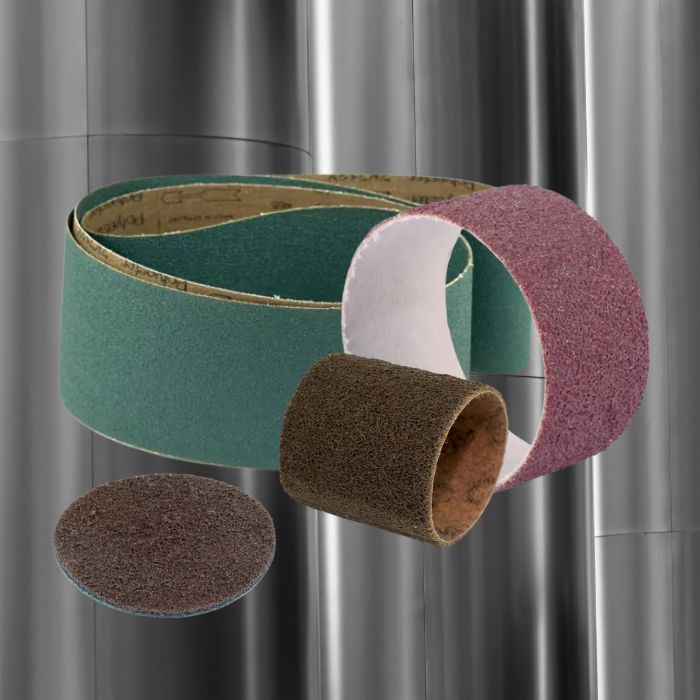
Abrasive belts and rolls
For surfaces, contours, tanks, tubes and repetitive processes.
Common mistakes when buying boilermaking abrasives
Buying by family without defining the operation
Saying “we need discs” is not enough. Separate cutting, grinding, blending, cleaning and finishing. Each stage has a different logic, and an error in the first operation can multiply rework later.
Using the same consumable for steel and stainless steel
If stainless steel must keep its surface quality, avoid ferritic contamination and separate consumables. Heat, pressure and finishing sequence also need control.
Measuring only unit price
The real cost includes time, changeovers, stoppages, rejected parts, finish and safety. A higher-priced abrasive can be more profitable if it reduces rework and keeps performance stable.
Ignoring the backing pad or accessory
If there is vibration, marking or irregular wear, the abrasive is not always the problem. It may be the pad, the machine, the mounting or the pressure applied by the operator.
Abrasteel as an industrial boilermaking abrasives supplier
Abrasteel works with abrasives for metal, stainless steel and industrial applications through a technical, consultative approach. Our catalogue covers cutting, grinding, flap discs, fibre discs, brushes, belts, Clean Strip, mounted points, accessories and finishing products for workshops, boilermaking shops, maintenance, welding, structural metalwork and professional distributors.
We can help you review current consumption, detect duplicate references, define a sequence by operation and align purchasing with material, machine and finish. This is especially useful when there is recurring consumption, stock pressure, short service life or rework caused by marks, heat or vibration.
Next step: prepare material, operation, machine, approximate monthly consumption and current problem. With those data, Abrasteel can guide the abrasive family and the most suitable references.
Frequently Asked Questions (FAQs)
Which industrial boilermaking abrasives are essential?
The most common families are cutting discs, grinding discs, flap discs, fibre discs, abrasive brushes, belts, rolls, Clean Strip discs, mounted points and accessories. Priority depends on whether the shop cuts, grinds, cleans, sands, prepares or finishes metal parts.
How should stainless steel abrasives be selected in boilermaking?
Avoid cross-contamination, control heat and choose products suitable for stainless steel. It is also advisable to separate carbon steel and stainless steel consumables when corrosion resistance or visible finish matters.
What is the difference between a grinding disc and a flap disc?
A grinding disc removes material more aggressively and supports lateral pressure. A flap disc combines removal and finishing, so it is usually used for blending, reducing marks or preparing a later stage.
When should abrasive brushes be used in boilermaking?
Use them to remove rust, paint, scale, superficial residue and contamination without removing as much base material as a grinding disc. Choose the format according to machine, surface and required aggressiveness.
How can cost per operation be reduced?
Measure parts worked, operator time, consumable changes, rework and final quality. Then compare abrasive families against the complete process, not only against unit price.
Does Abrasteel advise on abrasive selection for boilermaking?
Yes. Abrasteel can guide selection by material, operation, machine, consumption, expected finish and current problem. For a more precise recommendation, share dimensions, tool, process stage and workpiece type.
Abrasteel advice
Which abrasive do you need?
Tell us the material, operation, machine and expected finish. We help you organise the purchase.
Contact us
Leave us your details and one of our sales representatives will contact you shortly.