Grinding discs for welding
Technical guide for a perfect and cost-effective finish
In the metalworking industry, a perfect weld bead can be ruined in a matter of seconds if the wrong abrasive is chosen. Weld grinding is not simply “cleaning” the piece; it is a critical manufacturing process that affects mechanical strength, corrosion resistance, and the final cost per piece produced.
For workshop managers and skilled operators, the daily challenge is balancing working speed (Stock Removal Rate) with finish quality. A poor choice here leads to bottlenecks, material burn-through, or excessive consumable usage. As specialists in industrial abrasives since 1995, at Abrasteel we know there is no universal disc—only the precise tool for each application.
The strategic decision: Rigid grinding disc or flap disc?
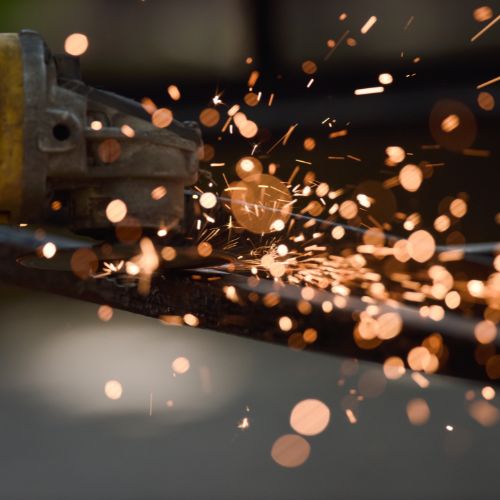
Before switching on the grinder, we must understand the physics behind each tool. Many workshops make the mistake of using the same disc for everything, losing efficiency.
Rigid grinding discs (Bonded Abrasives)
The conventional grinding disc (depressed center, type 27) is the workhorse tool for when the priority is massive material removal. Its hard bonded structure allows high pressure to be applied to the workpiece without the disc deforming.
- When to use them: Removal of heavy weld beads on carbon steels, plate beveling prior to welding, and foundry work where aesthetics are secondary.
- The Abrasteel Solution: For high-demand applications, our GRIND POWER line is specifically formulated to work with high-power grinders (1400W+). Its matrix allows aggressive grinding on alloy steels without glazing, a common problem where the disc loses cutting ability and only generates heat. If you are looking for a robust everyday option, the BASIC range offers the ideal balance between cost and performance.
- Technique: Remember to approach the weld bead at a 30°–40° angle. A smaller angle will cause uneven wear on the disc edge.
Flap Discs: Control and Finishing
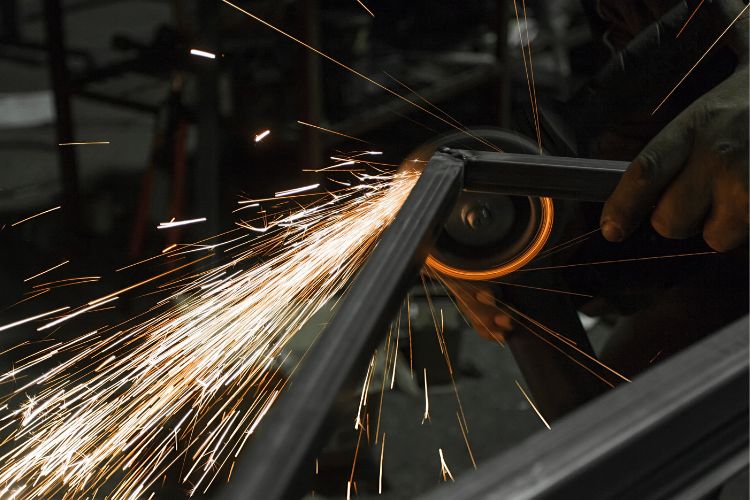
The flap disc has revolutionized weld finishing by allowing grinding and polishing in a single step (one-step finishing). Being composed of overlapping abrasive cloth flaps, it provides a “cushioning” effect that reduces vibration and noise.
- When to use them: Grinding weld beads on stainless steels, working on thin sheet metal (to avoid excessive thinning or undercutting of the piece), and surface preparation for painting.
- The Thermal Advantage: The spacing between the flaps allows constant airflow, resulting in a cool cut. This is vital to avoid the Heat-Affected Zone (HAZ), which appears as a bluish discoloration on stainless steel and indicates a loss of corrosion resistance.
- The Abrasteel Solution: For demanding welds, we recommend the CERAMIC flap disc. Its ceramic grain has self-sharpening properties: as it is used, the grain microscopically fractures, creating new cutting edges and maintaining aggressiveness throughout the disc’s lifespan.
Technical selection according to base material: Not all metals are the same
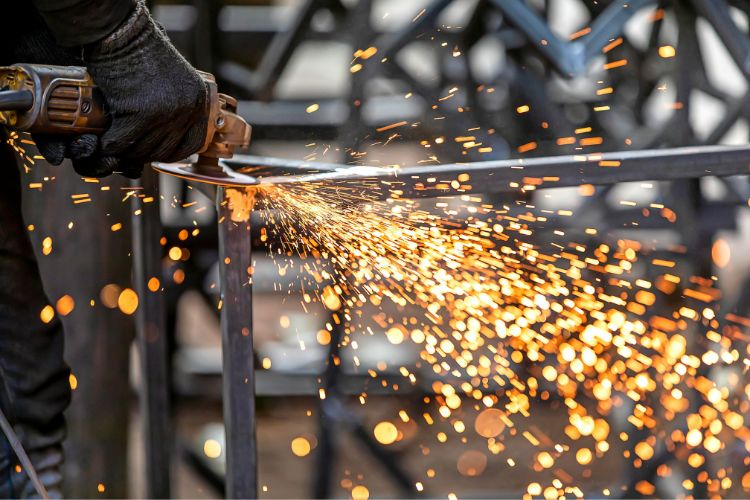
A critical mistake in consumable management is looking for a “universal disc.” The metallurgy of stainless steel and aluminum is opposite, and treating them with the same tool guarantees mediocre results and costly rework.
Welding on Stainless Steel (INOX): The enemy is temperature
Stainless steel has much lower thermal conductivity than carbon steel. This means that the heat generated by friction does not dissipate, but concentrates in the cutting area. If it overheats, thermal discoloration (Heat Tint) appears, which destroys the chromium passive layer and opens the door to future corrosion.
- The Requirement: It is imperative to use discs certified as “Contaminant-Free” (Fe, S, Cl < 0.1%). Using a standard disc will introduce iron and sulfur particles into the weld bead, causing rust spots in less than 48 hours.
The Abrasteel Solution
- For heavy grinding: We recommend our GRIND POWER line. Its specific formulation allows working with high pressure on stainless steel without generating the excess heat that crystallizes (“glazes”) conventional discs.
- For fine finishing: The CERAMIC flap disc is the superior choice. Its self-sharpening microcrystalline ceramic grain cuts cooler than traditional zirconia, drastically reducing the risk of burn marks on the workpiece and minimizing subsequent passivation times.
Aluminum and Non-Ferrous Metals: The Problem of “Dulling”
Aluminum, being a soft and ductile material with a low melting point, presents a different challenge: clogging. A standard grinding disc quickly “clogs”; the aluminum melts and sticks to the disc’s pores, covering the abrasive grain and rendering it useless within minutes.
- The Common Mistake: Many operators try to compensate by applying more pressure, which only generates more heat and can deform the workpiece or break the disc.
- The Abrasteel Solution: Our ALUMINUM grinding disc is designed with an open structure and special active fillers that act as a solid lubricant. This prevents material from sticking to the disc, maintaining aggressive cutting throughout its lifespan and preventing the disc from becoming a paperweight after just two minutes of use.
The Golden Rule: Avoid Cross-Contamination
In mixed workshops where different metals are worked on, discipline is vital.
- Never use on stainless steel a disc that has previously touched carbon steel. Microscopic iron particles retained in the abrasive will transfer to the stainless steel (a phenomenon known as cross-contamination), ruining its corrosion resistance.
- Expert Tip: We recommend visually marking grinders or discs dedicated to INOX (for example, with a paint mark or tape) to avoid operational mistakes amid the heat of daily work.
Where Technique Outweighs the Tool
Even the best abrasive disc will fail if the operator’s technique is poor. We have identified the three most common workshop mistakes that can reduce disc lifespan by up to 40%:
Incorrect Attack Angle
Geometry matters. Using a disc at the wrong angle causes uneven wear and can be dangerous.
For Rigid Grinding Discs (Type 27)
The optimal angle is 30° to 40°. If you work too flat, the fiberglass reinforcement mesh rubs against the weld, fraying and compromising the disc’s structural integrity. If it is too vertical, you will create deep grooves (gouging) in the workpiece.
For Flap Discs
If you use our Conical version (Type 29), maintain an angle of 15° to 25° to maximize contact and aggressiveness. For Flat versions (Type 27), work almost parallel to the surface (0° to 15°) for fine finishes and blending.
Excessive pressure
There is a myth that “pressing harder” means “cutting faster.” False.
The Reality
Excessive pressure reduces the grinder’s RPM, takes the tool out of its optimal torque zone, and generates excessive heat that crystallizes the abrasive grain (glazing).
The Correct Technique
Apply only the weight of the machine and guide the movement. If you feel the disc isn’t cutting without pushing, the disc is likely dull or of a specification too hard for the material.
Not Respecting Cooling Times
In long welds, the heat accumulated from grinding can add to the residual heat of the weld, deforming the sheet metal. Make short passes and allow the material to “breathe.”
Regulatory Safety: Your Guarantee and Ours
In an industrial environment, a disc spinning at 11,000 RPM is a critical piece of engineering. Structural failure is not an option.
At Abrasteel, we don’t leave safety to chance. All our rigid and flexible abrasives strictly comply with:
- European Standard EN12413: Mandatory requirement that certifies resistance to breakage, imbalance, and maximum operating speed.
- oSa Certification (Organization for the Safety of Abrasives): The global mark of excellence. Only manufacturers that subject their products to destructive audits and rigorous impact testing can carry this symbol.
Why does this matter to your purchasing manager? Using oSa-certified discs not only protects the operator; it protects the company from civil liability in case of an accident. In audited sectors such as naval or aerospace, traceability and certification of consumables (like that provided by Abrasteel) is mandatory.
Profitability is Safety and Precision
Choosing the right grinding disc for welding is not a minor expense on the spreadsheet; it is a decision that directly impacts production speed and the final quality of your product.
Whether you need the raw power of GRIND POWER for heavy structures or the surgical precision of the CERAMIC line for high-value stainless steel, at Abrasteel we have the exact reference.
Contact us
Leave us your details and one of our sales representatives will contact you shortly.